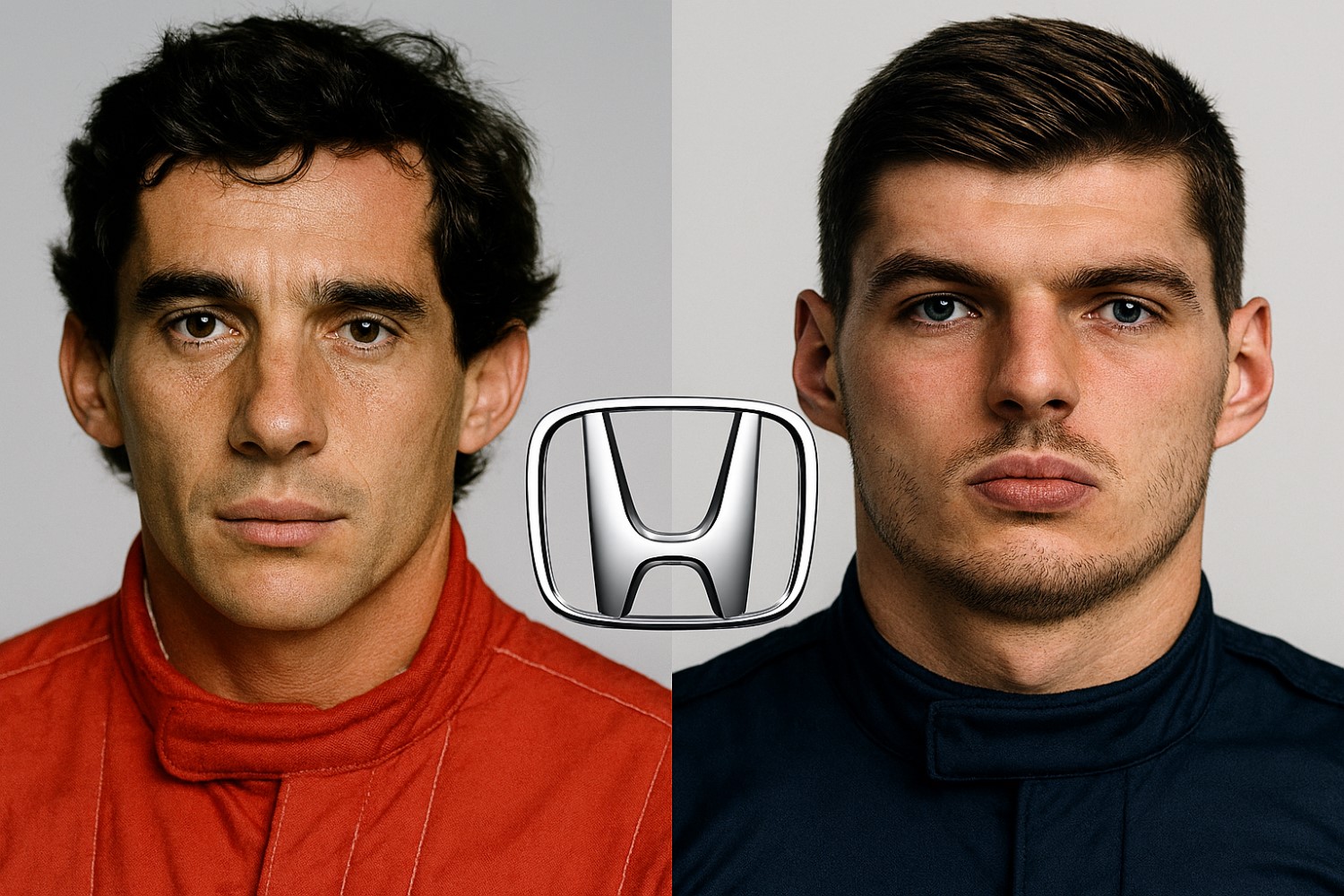
Honda’s Enduring Legacy in F1: The Partnerships with Ayrton Senna and Max Verstappen
Honda has been a pivotal force in Formula 1 since its entry as a full team and engine supplier in 1964, achieving its first victory in 1965 at the Mexican Grand Prix. Over the decades, the Japanese manufacturer has powered some of the sport’s most iconic drivers and teams, contributing to multiple world championships. Two drivers stand out for their profound impact on Honda’s F1 success: the late Brazilian legend Ayrton Senna and the Dutch four-time world champion Max Verstappen.
–by Mark Cipolloni–
Both formed dominant partnerships with Honda, delivering titles, record-breaking seasons, and a lasting bond with the company. This article explores their histories with Honda, drawing on factual achievements and recent reflections from Honda executives.
Ayrton Senna’s Era-Defining Collaboration with Honda (1987–1993)
Ayrton Senna’s relationship with Honda began in 1987 when he was driving for Lotus. That year, Lotus switched from Renault to Honda engines, fulfilling Senna’s long-held desire to race with the Japanese power units. Senna’s teammate was Satoru Nakajima, a key figure in Honda’s engine development. This initial partnership yielded immediate results: Senna secured two wins in 1987, including the Monaco Grand Prix, showcasing the engine’s potential.
The alliance reached its zenith when Honda partnered with McLaren in 1988. Senna joined the team alongside Alain Prost, forming one of F1’s most formidable lineups. The McLaren-Honda MP4/4, powered by Honda’s turbocharged V6 engine, dominated the season. McLaren won 15 out of 16 races, with Senna claiming eight victories and his first Drivers’ Championship. Honda secured the Constructors’ title as well. This near-perfect campaign set a benchmark for dominance in F1.
The success continued through 1991. In 1989, Senna won six races but lost the title to Prost amid controversy; however, Honda-powered McLaren retained the Constructors’ crown. Senna bounced back in 1990 and 1991, clinching back-to-back Drivers’ Championships with eight and seven wins, respectively. The 1991 season included Senna’s emotional home victory at the Brazilian Grand Prix in the McLaren MP4/6-Honda. Overall, the McLaren-Honda partnership from 1988 to 1991 produced 44 wins out of 80 races contested, three Drivers’ Championships for Senna, and four consecutive Constructors’ titles for the team (1988–1991).
Senna’s technical feedback was instrumental in refining Honda’s engines, pushing the limits of performance and reliability. Even after Honda’s official withdrawal from F1 at the end of 1992, Senna continued with McLaren in 1993 using Honda-derived engines under the Ford badge. His bond with Honda extended beyond the track; Senna’s passion and precision left an indelible mark on the company. In 2025, Honda congratulated Senna on his induction into the Automotive Hall of Fame, noting that his achievements continue to inspire engineers and fans worldwide.
Max Verstappen’s Modern Dominance with Honda (2018–2025)
Max Verstappen’s partnership with Honda began in 2018 through Red Bull’s junior team, Toro Rosso (now Racing Bulls). Honda, returning to F1 after a hiatus, supplied engines to Toro Rosso as a stepping stone. The collaboration expanded in 2019 when Honda became Red Bull Racing’s official power unit supplier, marking the start of a “works-style” partnership.
Verstappen’s first win with Honda power came at the 2019 Austrian Grand Prix, Honda’s first victory since 2006. The momentum built, culminating in Verstappen’s dramatic 2021 Drivers’ Championship win at the Abu Dhabi Grand Prix, edging out Lewis Hamilton on the final lap. This was Honda’s first Drivers’ title since Senna in 1991. Red Bull and Honda extended their deal multiple times, including support through 2025 via Red Bull Powertrains (RBPT), with Honda providing technical assistance.
The partnership’s peak came in 2023, when Red Bull won 21 out of 22 races, surpassing the 1988 McLaren-Honda record. Verstappen secured four Drivers’ Championships (2021–2024) and contributed to two Constructors’ titles for Red Bull (2022–2023). In 2025, Verstappen narrowly missed a fifth title by two points. Overall, the Red Bull-Honda era delivered 71 wins, 140 podiums, and four Drivers’ Championships across Red Bull and its sister team.
Honda’s engine development was key to Red Bull’s competitiveness, especially under the hybrid regulations introduced in 2014. Verstappen’s aggressive driving style and feedback mirrored Senna’s, helping Honda refine its power units. The partnership formally ended in 2025, with Honda shifting to Aston Martin for 2026 and Red Bull developing its own engines in collaboration with Ford.
Comparisons, Farewells, and Shared Legacies
Honda Racing Corporation president Koji Watanabe has drawn direct parallels between Senna and Verstappen, emphasizing their motivational impact on the company. In a 2025 farewell message, Watanabe stated that Verstappen is “incredibly popular in Japan,” associating him with Honda “just like in the days of Senna.” He highlighted Verstappen’s attitude, faith in Honda’s engineers, and shared goal of reaching the top, noting that the Dutch driver “will always be in our hearts.”
Statistically, comparisons abound. Senna started 161 Grands Prix, winning 41 (25.5% win rate) and securing 65 poles. Verstappen, by late 2025, had also started 161 races (as of 2022 data, with more since), amassing over 60 wins (exact figures post-2025 not specified here but exceeding Senna’s total). Verstappen matched Senna’s 41 wins at the 2023 Canadian Grand Prix. Pole position streaks show Senna’s record of eight consecutive poles in 1988–1989, while Verstappen achieved seven in 2023–2024.
F1 figures like David Coulthard rank Senna slightly above Verstappen in all-time lists, citing different eras and car technologies—Senna raced with less downforce and more manual controls. Helmut Marko, Red Bull advisor, noted similarities in character and charisma. Gabriel Bortoleto, a rising driver, praised Verstappen’s near-perfection but held Senna as his childhood hero. Former rival Terry Fullerton argued Verstappen’s consistency places him above Senna in some metrics.
Despite the end of the Red Bull-Honda partnership, Watanabe expressed openness to a future reunion with Verstappen, calling it “very exciting.” Red Bull bid farewell with a montage highlighting eight years of success.
Conclusion
Honda’s partnerships with Ayrton Senna and Max Verstappen represent two golden eras in F1, separated by decades but united by innovation, dominance, and driver-manufacturer synergy. Senna’s turbocharged triumphs in the late 1980s and early 1990s laid the foundation for Honda’s reputation, while Verstappen’s hybrid-era conquests revived it in the 2020s. As Honda moves to new challenges with Aston Martin and Red Bull forges ahead independently, the legacies of these collaborations endure, inspiring future generations in motorsport.