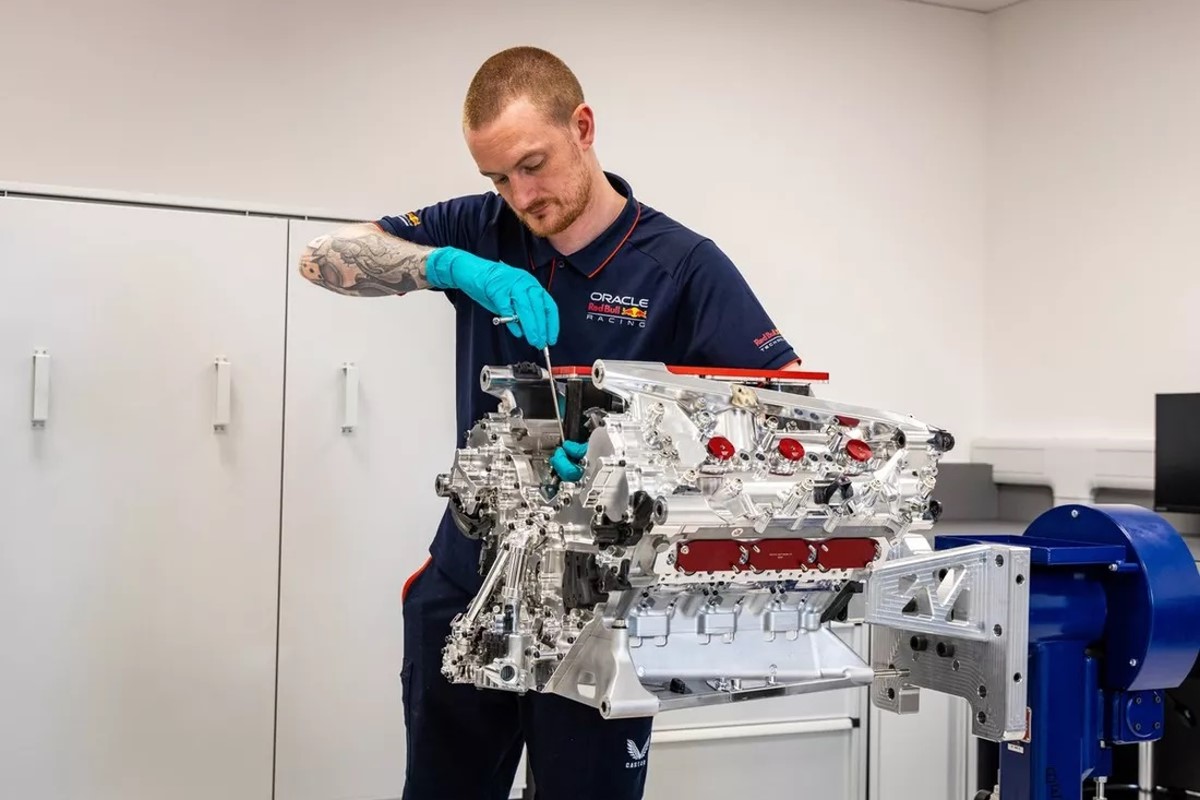
Formula 1 News: Ford a key partner in Red Bull Ford Powertrains F1 engine
As the 2026 Formula 1 regulations dawn, Oracle Red Bull Racing’s Detroit launch event—held in Ford’s backyard—unveiled a striking throwback blue livery for the RB22, paying homage to the American manufacturer’s storied motorsport past while signaling the deepening technical alliance ahead.
–by Mark Cipolloni–
The partnership, announced in 2023, sees Ford returning to F1 as a badge engineer and far more: a hands-on collaborator in Red Bull Powertrains’ ambitious project to design, build, and supply power units for both Red Bull Racing and Visa Cash App RB from 2026 through at least 2030.
Dismissing recent skepticism—notably from Cadillac CEO Dan Towriss, who called the deal “a marketing deal with very minimal impact”—Red Bull Ford Powertrains technical director Ben Hodgkinson firmly pushed back. “We’re super-proud of our partnership with Ford and it is very much a partnership,” he said ahead of the Detroit event.
While Red Bull handles the turbocharged V6 internal combustion engine, Ford’s engineers are deeply embedded in the electric hybrid components—the 50-50 split system central to the new rules. Ford personnel work side-by-side at Red Bull’s Milton Keynes campus, operating as a single integrated team.
Christian Hertrich, Ford Racing’s powertrain chief engineer, describes the seamless collaboration: “The fit was immediate. I was fully welcomed. My team has gone there, fully welcomed. And it’s the same as they come to us. They’re integrated. We operate as one.” He stresses the no-silos approach: “It’s not, ‘Hey, did you send Ford an email?’ It’s, ‘Hey, did you send *Jim* an email?’ There’s no separation.”
Beyond the hybrid expertise, Ford fills critical operational gaps for the rapidly expanding operation. Hodgkinson notes the challenge of assembling a ~700-person team from scratch: “The vast majority of my team are from the industry… putting 700 people together in a short space of time, I couldn’t find everybody I wanted, so that left a few holes. Ford have managed to provide some people to patch a few of those holes, which has been great… so yeah, there’s a direct involvement.”
Hodgkinson highlights manufacturing as perhaps the biggest win: “We’re able to make very complex 3D parts, parts that are so complicated you can’t machine them because of their geometry. And we’re able to do those really, really fast because Ford’s expertise in the area is really quite world-class. So that’s been a very big advantage.”
Supplier leverage adds another layer. “If you want to try and get an electric vehicle component supply company to be interested in supplying your 50 bits, they’re just not interested,” Hodgkinson explains. “There’s not enough margin for them. If Ford go knocking on the door, people answer. So having that name associated with us has been very, very useful indeed.”
Other contributions include advanced simulation tools—running 1,000 times faster than real-time—and expertise in noise, vibration, and harshness (NVH) analysis. Red Bull Powertrains’ Philip Prew recalls a vibration issue quickly resolved through Ford’s resources, while Hertrich notes driver-in-the-loop benefits: “When [Max Verstappen] jumps in and goes to the throttle, it will be the same response. You try to make that transition from simulation to track seamless.”
The knowledge transfer runs both ways, already boosting Ford’s GT3 and upcoming LMDh hypercar programs. As Hertrich puts it, integrated expertise is “the only way to level the playing field with the current [power unit] manufacturers.”
With testing underway and the new era approaching, Ford’s multifaceted role—from personnel and manufacturing to hybrid tech and procurement—proves the partnership is built for competition, not just branding. The Red Bull Ford Powertrains roar is ready to challenge the establishment.
Related Article: Formula 1 News: More Red Bull Ford Powertrains imagery