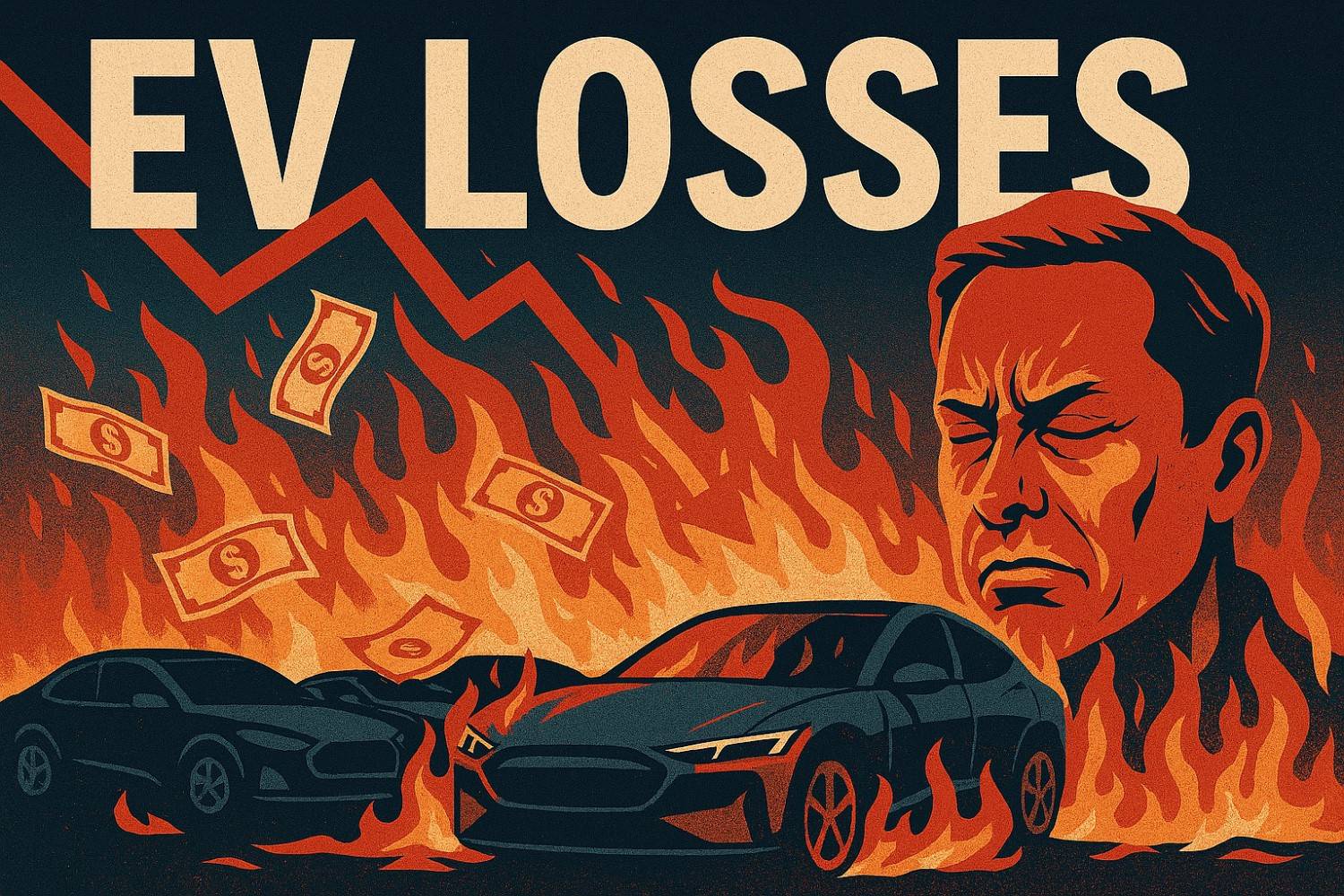
Automotive News: EVs Fiery Crash – A Tale of Face-Burning Losses
In the gleaming boardrooms of Detroit and Stuttgart, the air once buzzed with Electric Vehicle (EV) ambition. It was the early 2020s, a time when visionaries like Elon Musk and legacy giants like Ford and GM proclaimed the death of the internal combustion engine.
–by Mark Cipolloni–
Governments pumped in subsidies, investors poured trillions into battery plants, and carmakers bet the farm on a future where every driveway hummed with silent, zero-emission power. Over $188 billion flooded into U.S. EV and battery projects from 2015 to 2024 alone, fueled by regulatory mandates and the Inflation Reduction Act’s promises.
But by late 2025, that dream had ignited into a financial inferno, scorching balance sheets and leaving a trail of melted fortunes in its wake.
Picture Jake Harlan, a fictional mid-level executive at Ford’s EV division in Dearborn, Michigan. Jake had been riding high in 2023, overseeing the ramp-up of the Mustang Mach-E and F-150 Lightning. “This is the revolution,” he’d tell his team, echoing CEO Jim Farley’s bold pledges to electrify the lineup. Ford had sunk billions into factories, batteries, and tech, aiming to challenge Tesla’s dominance.
But as 2025 unfolded, the cracks appeared. Sales surged in Q3, thanks to frantic buyers snapping up vehicles before the $7,500 federal tax credit expired on September 30. Then, Q4 hit like a brick wall: U.S. EV sales plummeted 46% to just 234,000 units, dragging the market share down to 5.5%. Full-year sales scraped 1.28 million—a 2% drop from 2024, the first decline since 2019.
Jake watched in horror as dealer lots overflowed with unsold Mach-Es, their $59,000 average price tags scaring off buyers who flocked to cheaper hybrids, trucks, and SUVs. Range anxiety gnawed at consumers, amplified by spotty charging networks and plummeting gas prices.
“Why pay premium for a car that might leave you stranded?” one dealer grumbled in a leaked memo. Ford’s response? A staggering $19.5 billion write-down on EV assets, part of a broader retreat that included delaying new models and slashing production. Jake’s division reported $1.3 billion in quarterly losses, forcing layoffs and project cancellations.
Related Article: Automotive News: Ford Surrenders, admits EVs were a failure
Across town at General Motors, the story echoed with even louder thunder. Mary Barra’s empire had touted the Ultium battery platform as the key to an all-electric future. But by early 2026, GM announced a $6 billion writedown, unwinding ambitious plans amid the tax credit’s demise and softening demand. Production glitches plagued the Chevy Blazer EV and Silverado EV, while consumers balked at high costs and infrastructure woes.
Stellantis, Mercedes-Benz, and Volkswagen piled on, contributing to a collective $114 billion in EV losses across major automakers from 2022 to late 2025. Mercedes paused EQ model imports to the U.S., slashing prices by up to 16% in a desperate clearance. Volkswagen scrapped projects, lobbying for regulatory relief as European emissions mandates clashed with reality.
Even Tesla, the EV poster child, wasn’t immune. Elon Musk’s juggernaut saw deliveries drop 9% in 2025, with net profits plunging 46%. Musk pivoted to AI and robotics, ending production of the Model S and X. Startups like Lucid and Rivian bled red ink—$30.2 billion combined—despite flashy launches. Meanwhile, Chinese rivals like BYD surged ahead, overtaking Tesla as the world’s top EV seller, flooding markets with affordable models that undercut Western prices.
The bloodbath stemmed from a perfect storm: Overzealous investments met underwhelming demand. Regulatory U-turns under the Trump administration—revoking California’s EV mandates, easing emissions rules, and zeroing out fuel economy penalties—exacerbated the pain. Globally, EV sales grew 20% to 20.7 million in 2025, but the U.S. lagged with flat growth, risking industrial competitiveness as China dominated batteries and software.
As 2026 dawned, Jake Harlan stared at his inbox, filled with memos about “EV winter.” Forecasts predicted a 15% U.S. sales contraction, with global growth slowing to 12%. Yet glimmers emerged: New affordable models like the 2026 Chevy Bolt and Rivian R2 promised revival. Infrastructure improvements and battery tech advances hinted at a thaw.
For now, though, the industry licked its wounds, a cautionary tale of hype colliding with harsh economics. In the race to electrify, the finish line had moved farther away, leaving billions smoldering in the rearview mirror.