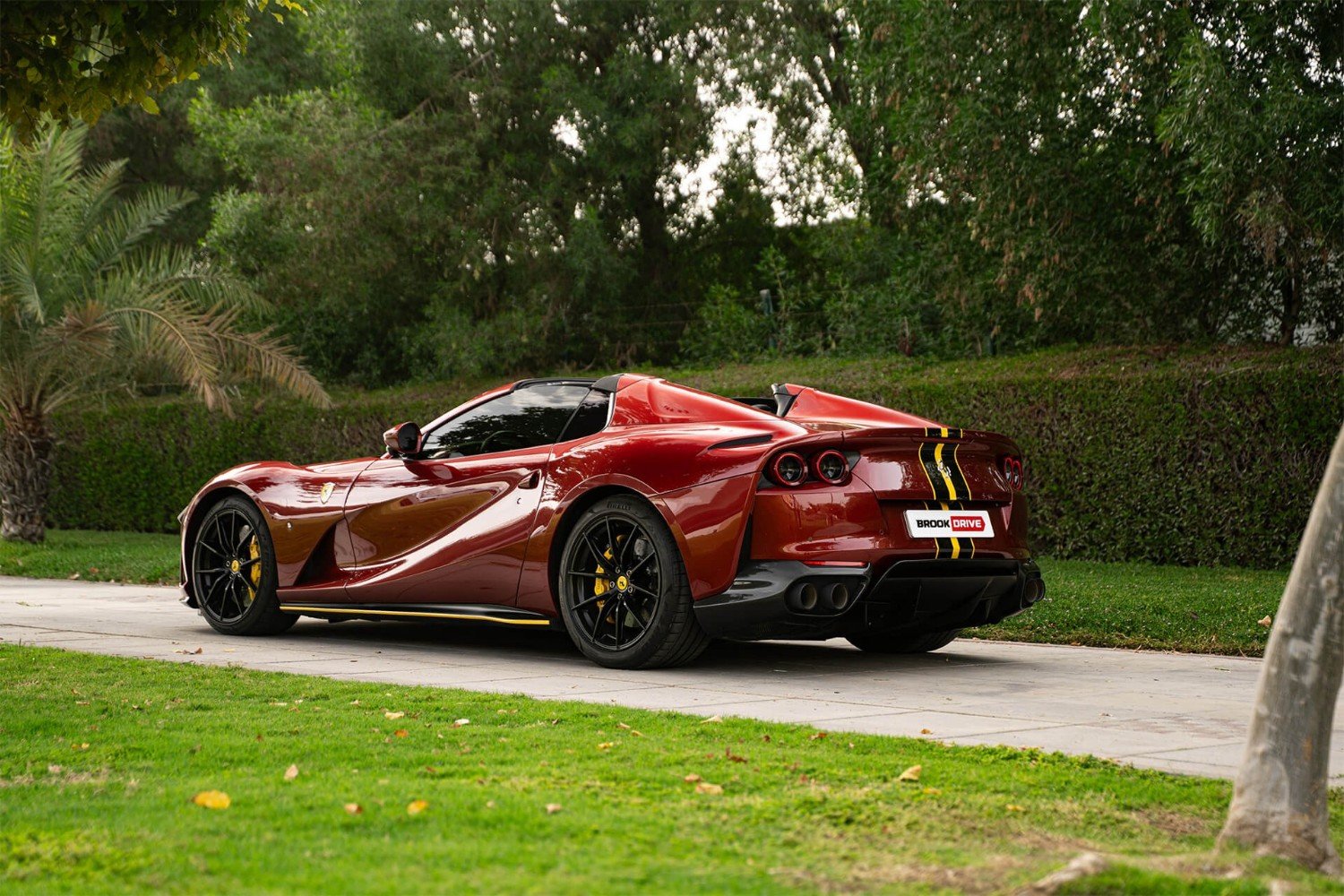
Automotive News: Ferrari F8 Tributo vs. SF90 Stradale
Modern Ferraris recalibrate a driver’s physiological baseline. The steering ratio is hyper-alert, the chassis communicates in high definition, and the powertrain responses are violently immediate. For those seeking the absolute pinnacle of Maranello’s engineering, the conversation inevitably narrows down to two titans: the F8 Tributo (pictured) and the SF90 Stradale.
Choosing between them isn’t a matter of superior performance—both offer more capability than any public road permits. It is a question of driving philosophy. One perfects the traditional, mid-engine V8 formula; the other introduces complex hypercar technology to street-legal architecture. Dubai, with its expansive highways and demanding driving culture, is perhaps the ultimate proving ground for these machines. For enthusiasts visiting the UAE and looking to settle the debate themselves, exploring Brook-Drive’s exclusive Ferrari fleet in Dubai offers the definitive opportunity to pilot both eras of Maranello’s engineering.
Here is the technical breakdown of how the F8 and SF90 translate Formula 1 DNA to the asphalt.
Two Eras of Scuderia Heritage
Every vehicle rolling out of the Maranello factory is a byproduct of track development. However, motorsport technology has fractured over the last decade, transitioning from pure internal combustion to complex hybrid deployment. This shift is exactly what divides the F8 and the SF90.
The F8 Tributo represents the absolute zenith of the outgoing analog era, celebrating the unassisted twin-turbo V8. The SF90 Stradale, meanwhile, directly mirrors current F1 grid technology, utilizing electrification not for efficiency, but for devastating torque-fill and lap-time obliteration.
Powertrain Dynamics: Mechanical Purity vs. Hybrid Architecture
The character of a Ferrari is dictated by its engine mapping and power delivery. While both cars utilize forced induction, their approach to putting power to the ground is fundamentally opposed.
F8 Tributo: The Zenith of the V8
The F8 was engineered specifically to honor Ferrari’s legendary 3.9-liter twin-turbo V8—a motor that has repeatedly secured the “International Engine of the Year” award. Mounted longitudinally behind the cabin, it produces 710 horsepower and 568 lb-ft of torque.
Ferrari engineered the F8 to feel deeply visceral. The track-focused Inconel exhaust system sheds weight and delivers a sharp, metallic frequency that builds toward the 8,000 RPM redline. Power delivery is linear and predictable. Through the Side Slip Control (SSC) system, the F8 allows the driver to manage rear-wheel traction with microscopic throttle inputs. It is a rear-wheel-drive purist’s machine—demanding respect, rewarding precise inputs, and communicating weight transfer flawlessly through the chassis.
SF90 Stradale: 1,000-HP Hybrid Deployment
The SF90 Stradale operates in hypercar territory. Ferrari heavily modified its V8 architecture, expanding it to 4.0 liters, and integrated three independent electric motors—two on the front axle and one (the MGUK) between the engine and the 8-speed dual-clutch transmission. The combined output is a staggering 986 horsepower.
The electric motors fundamentally alter the acceleration profile. Where traditional turbos require a fraction of a second to spool, the SF90 utilizes electrical torque-fill to bridge the gap. The throttle response is instantaneous. Furthermore, the twin front motors grant the SF90 all-wheel-drive capability (RAC-e), allowing for a 0-60 mph launch in a brutal 2.5 seconds. Through corners, the torque vectoring on the front axle pulls the nose toward the apex, delivering a level of mechanical grip that redefines the limits of street-legal physics.
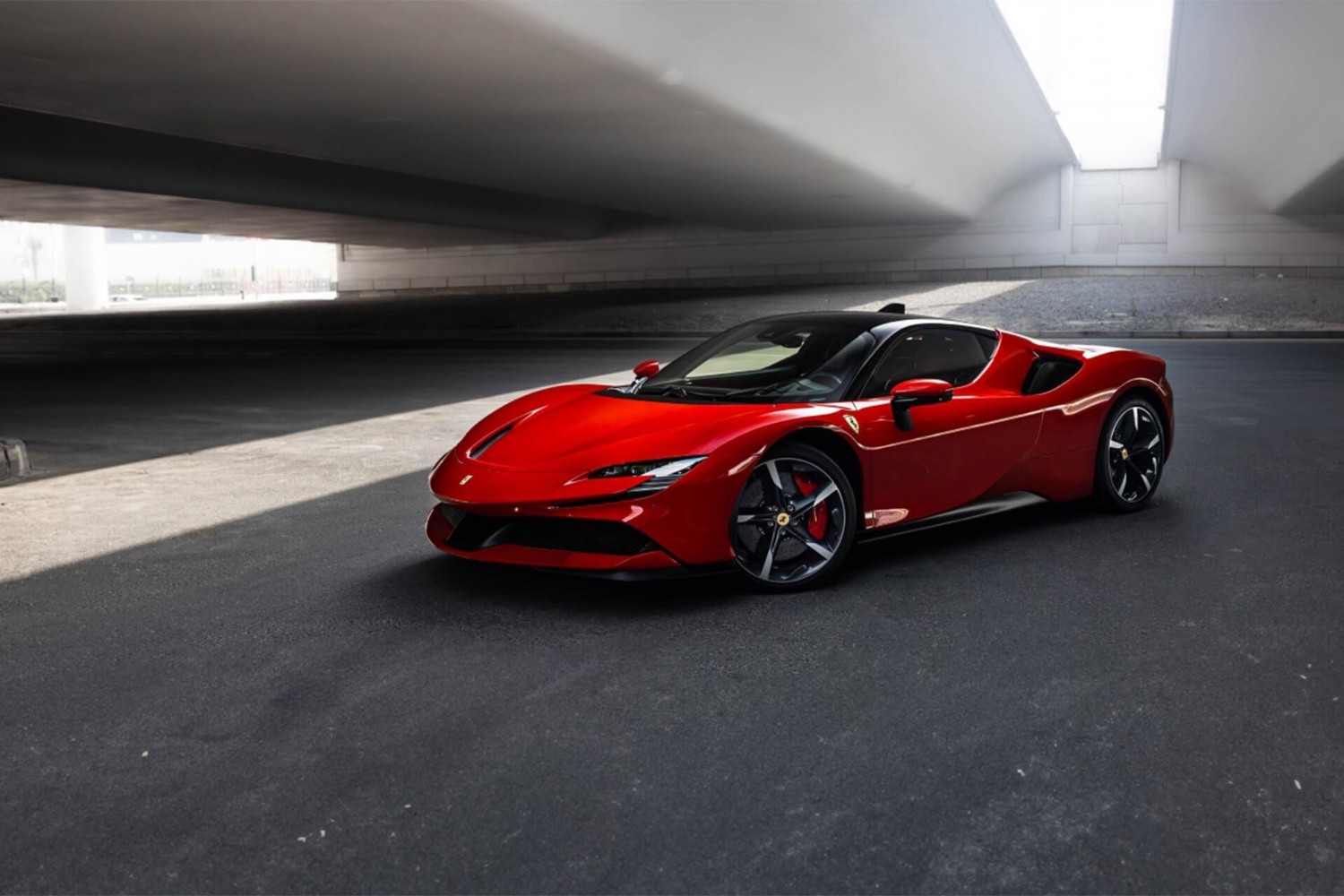
Aerodynamics and Downforce
Ferrari avoids massive, fixed rear wings on its standard production cars, opting instead to generate downforce through underbody vacuum effects and active aero-sculpting.
S-Duct vs. Shut-off Gurney
The F8 Tributo utilizes the S-Duct, a passive aerodynamic channel derived from Formula 1. High-pressure air enters the front bumper and is aggressively funneled upward through the hood, accelerating the airflow over the cockpit and generating immense front-axle downforce. This keeps the steering heavily weighted and precise during triple-digit sweeping corners.
The SF90 Stradale advances to active aerodynamics. Its signature component is the “shut-off Gurney” at the rear. Rather than a spoiler raising into the airflow, an electric actuator lowers a wedge of the rear bodywork under heavy braking or aggressive cornering. This creates a massive air-brake effect, closing off the under-wing airflow and generating a wall of downforce over the rear axle to stabilize the chassis.
Additionally, the SF90 utilizes a highly calibrated brake-by-wire system. The pedal input is managed by software that seamlessly blends regenerative braking from the electric motors with the raw stopping power of the carbon-ceramic discs, preventing brake fade without sacrificing pedal feel.
Head-to-Head Specifications
| Specification | Ferrari F8 Tributo | Ferrari SF90 Stradale |
| Powertrain | 3.9L Twin-Turbo V8 | 4.0L Twin-Turbo V8 + 3 Electric Motors |
| Total Output | 710 hp / 568 lb-ft | 986 hp / 590 lb-ft (engine only) |
| Drivetrain | Rear-Wheel Drive | All-Wheel Drive |
| Transmission | 7-Speed Dual-Clutch | 8-Speed Dual-Clutch |
| 0-60 mph | 2.9 seconds | 2.5 seconds |
| Top Speed | 211 mph | 211 mph |
| Dry Weight | 2,932 lbs | 3,461 lbs |
| Electric Range | N/A | Approx. 15 miles (eDrive mode) |
The specifications highlight the trade-offs. The SF90 dominates in sheer output and off-the-line traction. However, its complex hybrid system adds over 500 pounds of mass. The F8 Tributo’s lighter curb weight translates to a more agile, analog turn-in response during tight canyon carving.
The Verdict
The F8 Tributo is the ultimate refinement of the classic mid-engine Berlinetta. It is lighter, aggressively vocal, and demands a high level of driver engagement. It is the choice for purists who want to manage rear-wheel slip angles and experience the peak of Ferrari’s internal combustion era.
The SF90 Stradale is a technological tour de force. The AWD traction and instant electric torque provide hypercar-level performance with point-and-shoot confidence. The ability to glide silently through a city in eDrive mode before unleashing nearly 1,000 horsepower on the highway gives it a duality no older Ferrari possesses. It is the definitive choice for those who want the most advanced, uncompromising street car Maranello has ever engineered.
FAQ
Can you drive the SF90 Stradale entirely on electric power?
Yes. In eDrive mode, the V8 is decoupled, and the car operates purely on the two front electric motors. It provides roughly 15 miles of silent, front-wheel-drive range at speeds up to 84 mph—ideal for early-morning departures without disturbing a quiet neighborhood.
Is the F8 Tributo overly aggressive for city driving?
No. Despite its track-focused nature, the F8 is highly tractable at low speeds. With the Manettino dial set to “Sport” and the “Bumpy Road” suspension mode engaged, the magnetic dampers soften significantly, making it compliant over uneven city pavement.
Why does the SF90 lack a physical reverse gear?
To optimize weight and packaging. The SF90’s 8-speed dual-clutch transmission is smaller than the F8’s 7-speed unit because the physical reverse gear was eliminated. Reversing is handled entirely by the front electric motors.
Are these cars suitable for grand touring?
They are high-performance supercars, not grand tourers. The suspension is firm, the carbon-fiber seats are heavily bolstered, and cabin insulation is minimal. Furthermore, trunk space is strictly limited. The F8 offers a slightly larger front trunk (frunk) since it lacks the front-axle electric motors of the SF90, but both are best suited for short weekend getaways rather than cross-country trips.