Different Types of Headlights Explained: LED vs HID vs Halogen vs Laser
Motorsport has always been a proving ground for automotive technology—aerodynamics, tire compounds, braking systems, and hybrid powertrains all made their way from the racetrack to your driveway. Headlight technology is no different. The same demand for visibility at high speed that pushed engineers to develop better lighting for endurance racing has driven the evolution of every bulb type you’ll find on the road today.
Whether you’re swapping out a dying bulb on your daily driver, building a track day car, or just trying to understand why the car next to you at a stoplight has a completely different shade of white coming out of its headlights — here’s your complete guide to headlight bulb technology, told through the lens of motorsport.
Halogen Bulbs: The Old Reliable
Halogen bulbs have been the standard fitment on production cars for decades, and for most of the 20th century, they were the standard in racing too. Le Mans competitors, rally cars, and touring car racers all relied on halogen for decades before better options arrived. Inside the glass envelope, a tungsten filament burns inside a halogen gas mixture (typically iodine or bromine), which allows it to run hotter and brighter than a conventional incandescent without burning out prematurely.
On road cars, halogens are inexpensive—often under $20 a pair—and swappable in a parking lot with no special tools. They produce a warm, yellowish-white light that most drivers find natural and easy on the eyes.
The tradeoff: halogens waste a significant portion of their energy as heat, their lifespan caps out around 500 to 1,000 hours, and their output is modest by modern standards. In rally racing, teams used to carry spare bulbs and change them mid-stage—that tells you everything about their reliability limitations under demanding conditions.
Best for: Budget builds, older vehicles, or drivers who want simple, no-fuss replacements.
HID/Xenon Bulbs: Born on the Race Track
High-Intensity Discharge (HID) technology—commonly known as Xenon—wasn’t originally developed for motorsport, but it quickly became a benchmark lighting solution in professional racing once its performance advantages were proven under extreme conditions.
Before its introduction on the 1991 BMW 7 Series — widely recognized as the first production vehicle equipped with HID headlights — Xenon-based lighting had already been used in industrial and specialized applications where high-output, efficient illumination was critical.
Instead of relying on a heated filament, HID systems generate light by creating an electrical arc between two electrodes inside a quartz capsule filled with xenon gas.
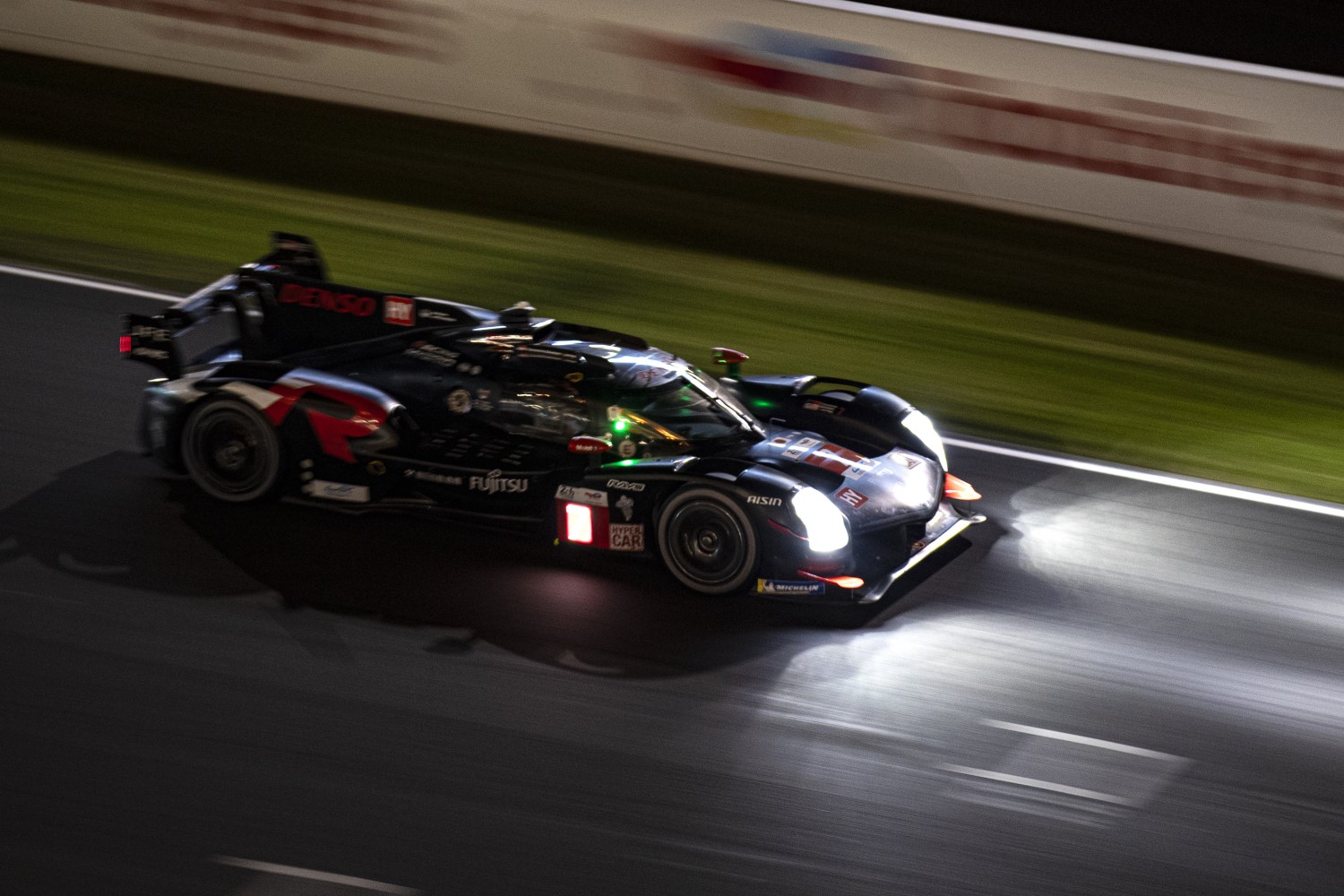
In endurance racing—including the 24 Hours of Le Mans, IMSA, and early WEC competition—HID lighting became the dominant standard throughout the late 1990s and 2000s. Its ability to project a long, intense beam made it especially valuable during high-speed night stints, where visibility directly impacts reaction time and driver safety.
Legendary race cars such as the Audi R8 LMP and Bentley Speed 8 utilized advanced HID systems, helping to set the benchmark for nighttime racing visibility and influencing the widespread adoption of HID technology in road vehicles during the same era.
On road cars, HID systems typically last 2,000+ hours and consume less power than halogen bulbs. However, they require a short warm-up period to reach full brightness, perform best in projector housings, and are more expensive to replace.
Best for: Drivers seeking a substantial upgrade over halogen, particularly on vehicles already equipped with projector headlights.
LED Headlights
Unlike traditional bulbs that rely on a heated filament (Halogen) or a high-voltage gas arc (HID), Light-Emitting Diodes (LEDs) are solid-state semiconductors. They produce light through a process called electroluminescence—when an electrical current passes through a microchip, it excites electrons that release energy in the form of photons. This “instant-on” technology eliminates the warm-up lag of older bulbs, providing a crisp, high-contrast light that closely mimics natural daylight.
While Formula 1 popularized high-intensity LED rain lights for their near-instant response and visibility in spray, it was endurance racing that truly pioneered LED headlight technology. In the grueling 24 Hours of Le Mans, LED arrays transformed night stints by providing a daylight-like color temperature that reduces driver fatigue. The compact nature of LEDs allowed LMP and GTE teams to shrink headlight housings, optimizing aerodynamics in ways that were impossible with bulkier halogen or HID units.
On road cars, this efficiency means LEDs can produce significantly more light while drawing less power from your vehicle’s electrical system. They reach full brightness instantly, last upward of 30,000 hours, and their small form factor has revolutionized modern automotive design, allowing for the sleek, “signature” lighting seen on almost every car in 2026.
The main challenge is thermal management: the LED elements themselves run cool, but their driver electronics generate heat that must be properly dissipated. Cheap aftermarket conversion kits frequently fail here, which is why a quality system from a reputable manufacturer is worth the premium. High-performance options, including some of the brightest LED headlight bulbs like SEALIGHT S7S, utilize advanced cooling to maintain the intense, focused beam pattern required for high-speed driving without the risk of premature failure.
Best for: Most modern drivers. If your car was built in the last five years and came with halogens as base spec, a quality LED headlight bulb upgrade is the single best lighting improvement you can make.
Laser Headlights
If there’s one headlight technology that most directly reflects the demands of top-level endurance racing, it’s laser. These systems work by firing a laser at a phosphor element, which converts the concentrated beam into a broad, intense white light. The result can illuminate the road up to 600 meters ahead — roughly double the range of the best LED systems.
That kind of reach isn’t a vanity specification. At the 24 Hours of Le Mans, prototype cars hit 200+ mph down the Mulsanne Straight in the dead of night. The margin between seeing a lapped car or debris in time and not seeing it is measured in fractions of a second. When Audi debuted laser headlights on its R18 e-tron quattro LMP1 car at Le Mans in 2014 — the same year BMW introduced them on the road-going i8 — it wasn’t a marketing exercise. It was a direct response to the visibility demands of the world’s most grueling race.
Since then, laser headlights have spread to select high-end BMW and Audi road models. The catch is cost. Laser systems are expensive at every stage — original equipment, replacement units, and repair. They remain firmly in premium and sports car territory for now, with no retrofit path for existing vehicles.
Best for: High-end new car buyers who spend meaningful time at highway speeds on unlit roads, and anyone speccing a modern sports car where this option is available.
What This Means for Your Car
Racing engineering has a long history of filtering down to the cars we drive every day. The headlight in your driveway is a direct descendant of the lighting technology that helped drivers survive night stints at Le Mans, navigate blind crests in the Monte Carlo Rally, and thread through backmarkers in the dark at the Nürburgring.
Here’s where each technology stands today:
| Bulb Type | Brightness | Lifespan | Cost | Racing Pedigree |
| Halogen | Low–Moderate | 500–1,000 hrs | $ | Rally, touring cars (historical) |
| HID/Xenon | High | 2,000+ hrs | $$ | WEC, Le Mans (1990s–2010s) |
| LED | High | 15,000–30,000 hrs | $$–$$$ | F1, modern endurance racing |
| Laser | Highest | 30,000+ hrs | $$$$ | LMP1, premium road cars |
If your car still runs halogens and you want a genuine upgrade, a properly installed LED or HID system will transform your night driving. Just make sure whatever you fit throws the light where it belongs — on the road ahead, not into the face of the driver coming the other way. That rule applies whether you’re doing 30 mph on a suburban street or 150 mph down the straight at Road Atlanta.