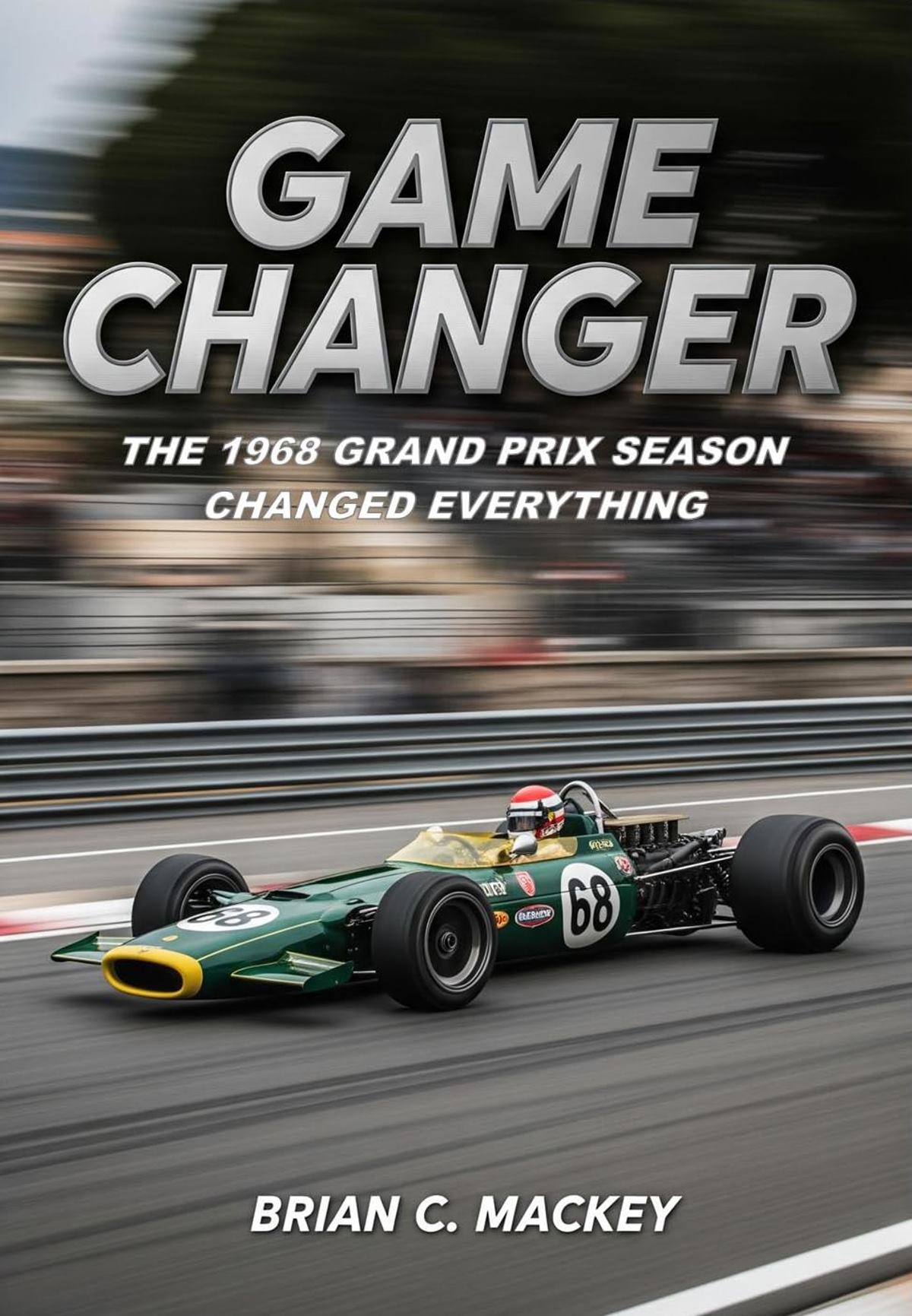
Game Changer: The 1968 Grand Prix season changed everything
The 1968 Formula One season did not begin with a starting gun. It began with a boy’s sixteenth birthday.
–by Mark Cipolloni–
Brian Mackey was that boy—fresh-faced, American, living temporarily in England with his family. On July 20, his father handed him tickets to the British Grand Prix at Brands Hatch. He knew almost nothing about the sport. He had never seen a Grand Prix car in the flesh. Yet the moment the field thundered past the pits, he was hooked forever. What he witnessed that sunny afternoon was pure theater: color, noise, danger, glory. What he could not see—what no one standing in the grandstands could see—was the gathering storm that had already begun to tear the sport apart.
This book is the context he lacked that day.
The 1968 season opened, fittingly enough, on New Year’s Day at Kyalami, South Africa. Most insiders expected more of the same: another year of Lotus dominance, another procession led by the brilliant Jim Clark. Instead, they got revolution.
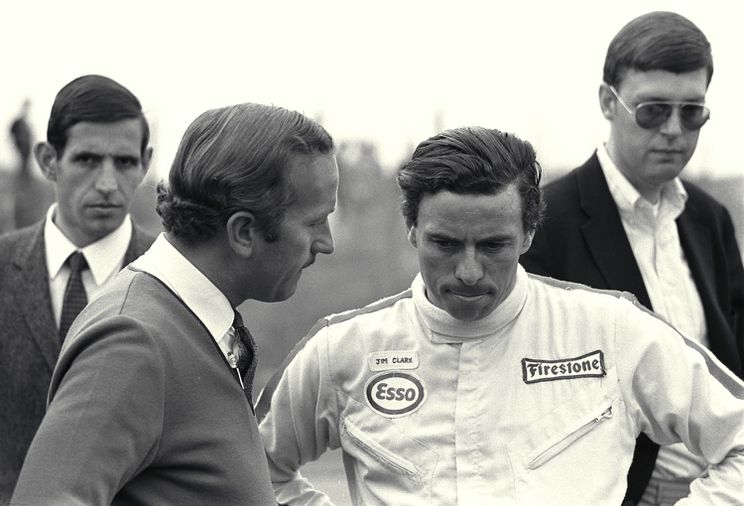
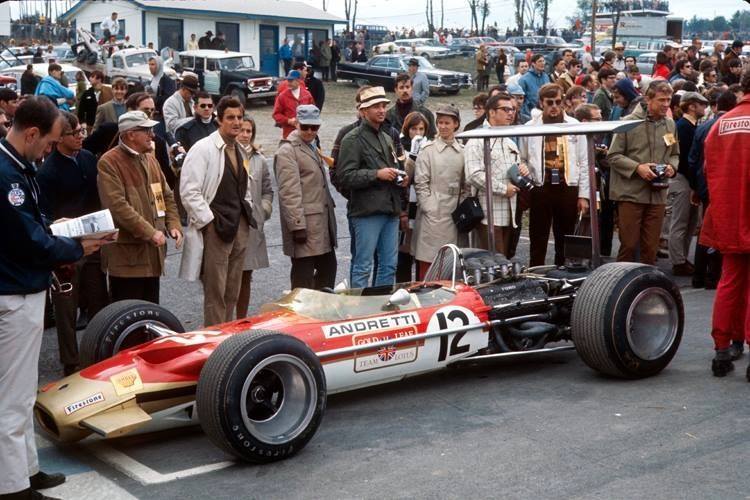
The Cosworth DFV engine arrived like a thunderclap, cheap enough for privateers yet powerful enough to humble the factories. Wings and spoilers began their tentative, awkward rise, the first clumsy steps toward aerodynamics that would soon reshape every corner of every circuit. Sponsorship money—bright, brash, and unapologetic—flooded in, promising to drag the sport out of its gentleman-amateur past and into a slick, professional future. The cars looked faster. The future looked brighter.
Then the deaths began.
Four Grand Prix drivers lost their lives in a single season. Jim Clark, Mike Spence, Jo Schlesser, Ludovico Scarfiotti. Not all in World Championship events, but every one of them a name the paddock knew and loved. The fatalities came in clusters so relentless that journalists and drivers began speaking of “the 91 days of hell”—a three-month stretch of grief so profound it forced the entire sport to stare into the abyss and ask whether the price of progress had become unbearable.
This is the brutal, beautiful contradiction at the heart of 1968: dazzling innovation on one side of the garage door, soul-crushing loss on the other. A season that gave us the foundations of modern Formula One—engine technology, aerodynamic thinking, commercial scale—while nearly killing the thing it was trying to save.
It is a story Mackey carried with him for more than half a century. Not as a dry chronicle of lap times and points tallies, but as a human drama that reads like a thriller because it was a thriller: genius against grief, courage against fear, old money and new ideas colliding at 180 miles per hour. Mackey has stepped back from the race-by-race timeline only when necessary—to explain Ford’s corporate gamble, the quiet birth of sponsorship as we know it today, the first desperate calls for safety that would echo for decades.
You will not find a technical manual here, nor a reference book of every practice session and tire compound. You will find the living, breathing season as it felt to those inside it—and as it felt, years later, to the boy who stood in the Brands Hatch grandstand on his sixteenth birthday, oblivious to the revolution and the mourning that surrounded him.
This is the story of the year Formula One changed forever.
The year providence chose for transformation.
The year the sport looked into the unholy hell of its own making—and decided, against every instinct of survival, to keep racing anyway.
Check out the book here.
Additional Photos/Video
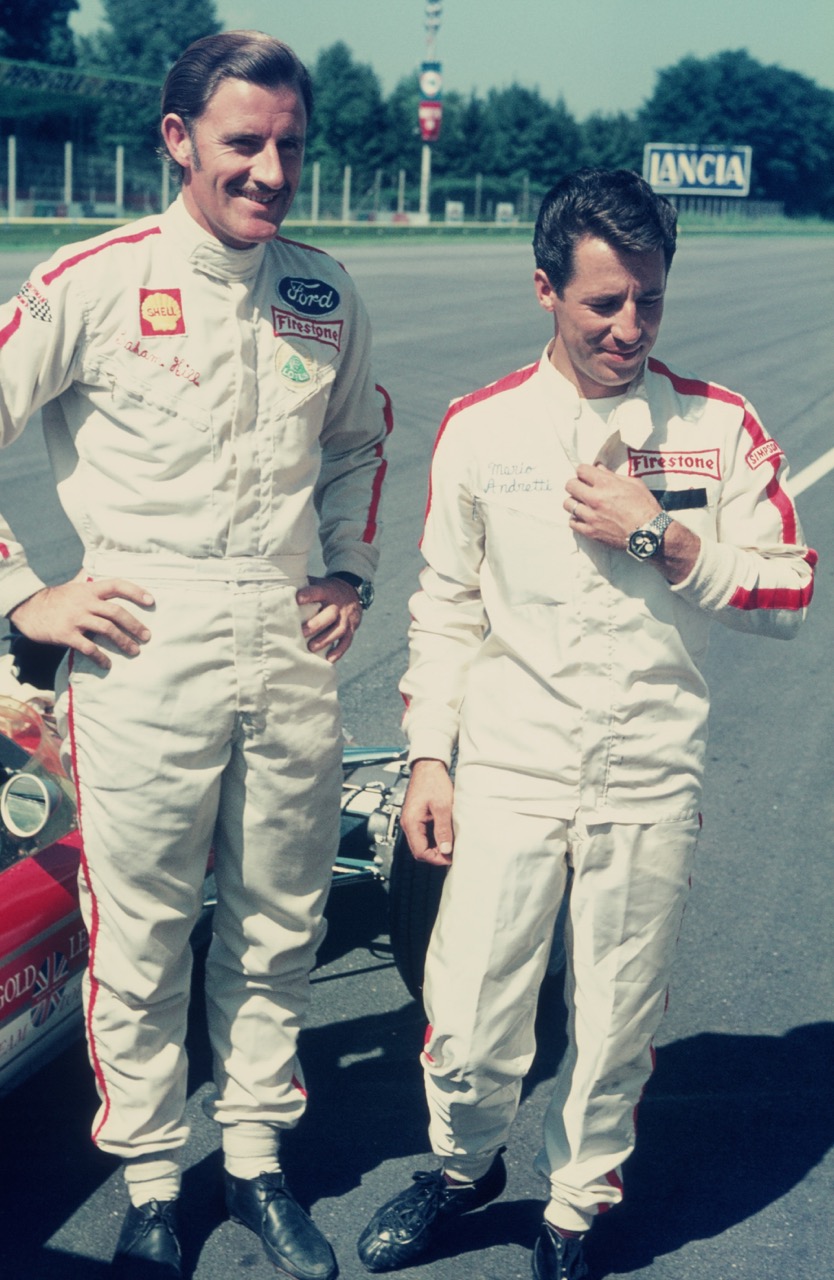
Fred Gamble, who, as of May 1993 resided in Snowmass, Colorado, wrote to ON TRACK magazine and, in the 23 May ’93 issue, his letter – headed “Time For The Truth” – was published. gamble had this to say:
“Concerning the circumstances of Jimmy Clark’s death…maybe it is time the truth is told. I was privileged to be a part of that era and a friend of Jimmy’s, so was just as devastated as everyone else when he was killed. His car had a rear suspension failure; sadly one of the frequent and well-known results of the brilliant but fragile Lotus cars of that era. I was Goodyear’s first director of international racing at the time and, as Firestone was contracted to Lotus, after the accident and rumors of a tire failure, Firestone engineers showed me the tire off the Clark car, no puncture, but obviously dragged sideways after a suspension failure. Jimmy would have had a chance of dealing with a puncture and deflation but suspension failure, no way could he have controlled the car. I can understand Firestone not wanting to ‘blame’ Lotus car failure because of their corporate relationship with Lotus and Colin Chapman…I think those of us in the sport at the time who knew the details of Jimmy’s death have probably kept quiet out of respect for Colin Champam’s brilliance as a designer, but more because the great Jim Clark was like a son to Chapman. Furthermore, I’m sure that Chapman knew the cause of the accident but to have been publicly condemned for a fragile design failure might have been emotionally too much for Colin to bear.”