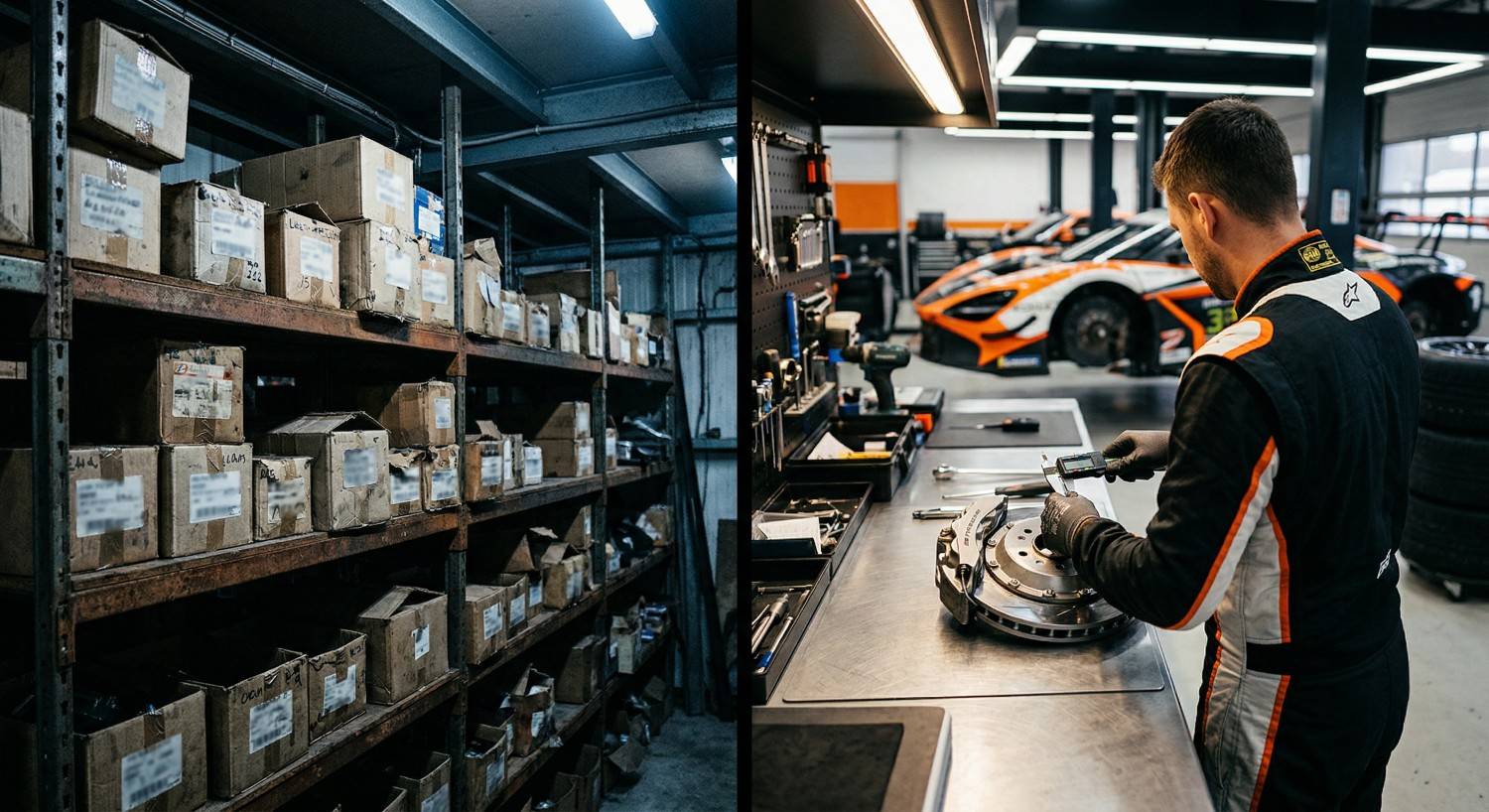
Automotive News: Not every cheap part is a fake, and not every fake part is cheap
Formula 1 engineers don’t use a part because it carries the right logo. They use it because it has the right specifications. NASCAR crew chiefs think the same way. However, many motorists fail to understand this distinction, which is why millions of them either overpay for OEM parts they don’t need or unknowingly install counterfeit parts that don’t meet the standards required.
What racing figured out that most drivers haven’t
Both F1 teams and NASCAR outfits have run certified aftermarket and OES-level components for decades. Not because they cut corners, but because verified specs and traceable supply chains matter more than the name on the box. A component either meets the load, temperature, and tolerance requirements or it doesn’t. Brand loyalty has no place in a pit lane, and it shouldn’t have much place in your garage either.
The real question was never original or budget. It was always authentic or counterfeit.
OE, OEM, and aftermarket: three categories drivers keep mixing up
Not every non-original part is a counterfeit. The market runs on three distinct tiers. OE parts come directly from the vehicle manufacturer. OEM components are produced by the same suppliers that make OE parts, but are under a different label and often at a lower price. Aftermarket brands like Ridex or Topran sit in the third tier. They are independently manufactured and designed to meet or exceed the original specifications.
The confusion between these categories costs drivers money. A legitimate OEM or aftermarket part can perform identically to the original, whereas a counterfeit cannot.
The real threat isn’t the budget brand it’s the fake one
In fiscal year 2024, U.S. Customs and Border Protection seized over 211,000 counterfeit automotive parts. This was nearly double the previous year’s figure, according to the Automotive Anti-Counterfeiting Council (A2C2).
A survey conducted by the IPO (Intellectual Property Office ) UK revealed that more than 45% of motorists found out that a part they had bought was a fake through their garage after the part faulted.
Alexandru Lazariuc, Technical Specialist in Auto Parts Selection, explains his rule of thumb on LinkedIn:
“If a part is €100 at market price but offered for €20 – I consider this a 99% counterfeit … miracles don’t happen in our industry.”
While a genuine alternative brand priced 25–35% below OEM is a calculated business decision, a part priced 80% below market is a red flag.
Three problems every online buyer runs into sooner or later
Unauthorized substitution. You order a specific brand and a different one arrives. This happens across most online platforms when stock runs short and automated systems make the swap. The result: a part that may not fit, with returns at your expense.
Compatibility errors. A single car model can carry five or six hardware variants across years and trim levels. Catalogues often show compatibility where none exists. The fix is rarely simple and costs time, shipping, and patience.
Supplier data errors. Sometimes the platform isn’t the problem. Suppliers provide incorrect specifications, and the wrong part ships despite accurate catalog entries.
Data from AUTODOC, one of Europe’s leading online parts retailers, shows how these issues can be handled systematically: substitutions are offered only after explicit customer approval; a multi-layer fitment system combines VIN-based filtering, product photographs, and pre-purchase specialist verification. If a part is incompatible, free replacement or return within 14 days is offered. In case of a supplier error, the correct part is dispatched without delay.
When a budget brand is actually the right call
AUTODOC’s own brands RIDEX and goCORE illustrate what a legitimate alternative looks like in practice. RIDEX offers thousands of different parts for European and American vehicles, manufactured to OE-level specifications. goCORE focuses on everyday wear components in systems like braking, suspension, and filtration. Both are produced under verifiable quality control and carry full warranty coverage.
Lazariuc adds a broader dimension to the quality question:
“Over the past six months, I’ve encountered two cases where the declared material composition did not match the actual composition. This resulted in wasted time, reordering batches, and explanations to the customer.”
The EU’s revised ELV (End-of-Life Vehicles) framework that introduces Digital Product Passports with full material traceability will make verified composition data a legal requirement rather than a competitive advantage.
What to remember before your next order
F1 teams don’t gamble on unverified components, and neither should you. Check the supplier, use the VIN to ensure compatibility, and take a look at the return policy before you order. Remember that if a price looks too good to be true in the automotive parts market, it probably is.
Sources: Automotive Anti-Counterfeiting Council (A2C2), U.S. Customs and Border Protection (CBP), Alexandru Lazariuc via LinkedIn, AUTODOC internal data.