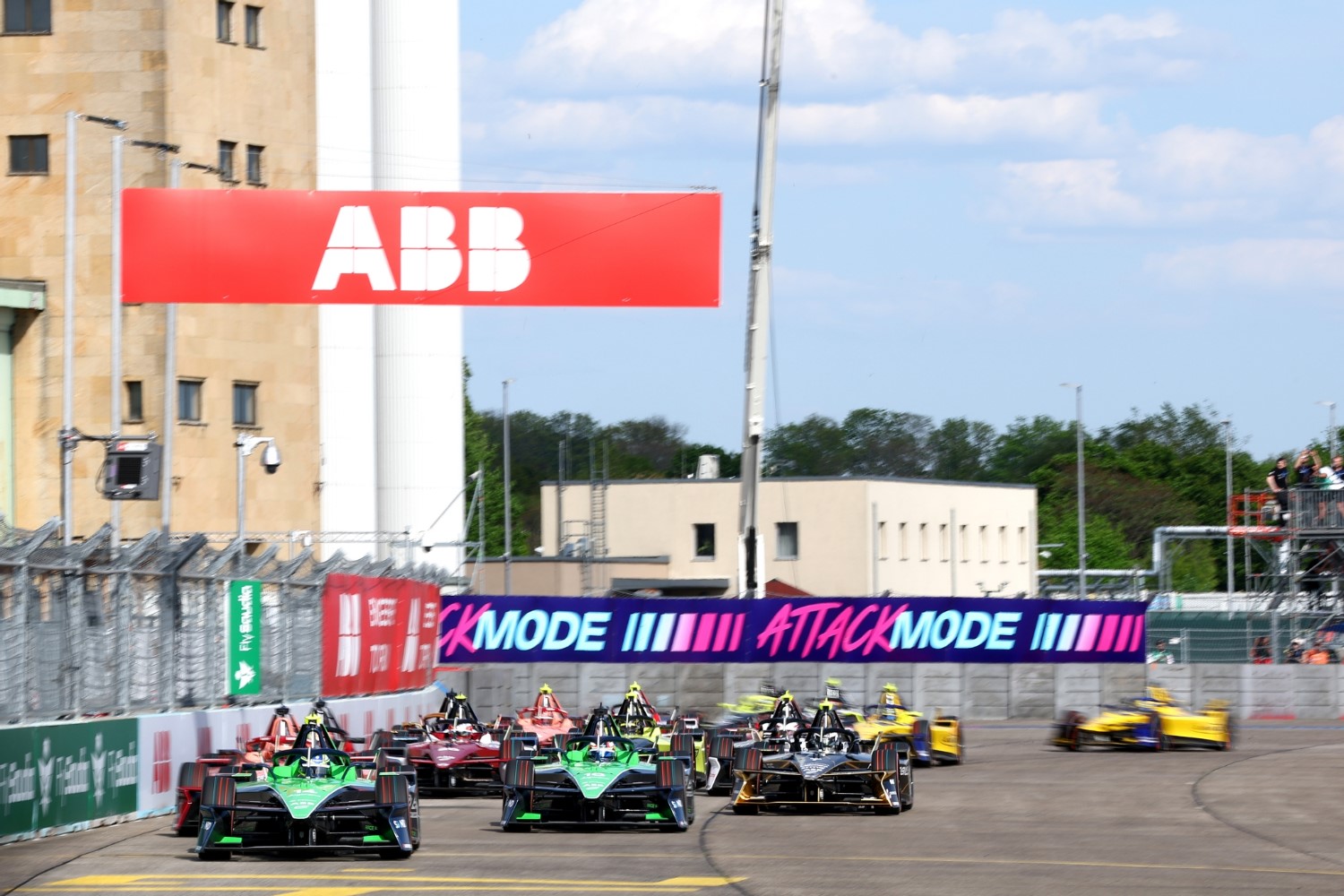
Energy management instead of driver skill defines Formula E racing
The ABB FIA Formula E World Championship returned to its only permanent calendar fixture since Season 1—the Tempelhof Airport Street Circuit in Berlin—for Rounds 7 and 8 on May 2-3, 2026. Both 39-lap E-Prix races were a masterclasses in energy conservation rather than flat-out racing.
–by Mark Cipolloni–
Drivers and teams prioritized lift-and-coast techniques, precise regen harvesting, strategic PIT BOOST timing (a 30-second mandatory stop for +10% extra energy), and Attack Mode activations (extra power in designated zones, limited to one or two uses totaling six minutes) over aggressive early pacing. This approach frequently produced “convoy” or pack-style racing, where drivers deliberately dropped back to save energy and let others burn theirs leading into the wind.
The weekend delivered two contrasting winners but the same overarching theme: energy strategy trumped raw pace and wheel-to-wheel aggression, illustrating how Formula E’s unique constraints shift the emphasis from traditional driver skill (constant maximum attack, bravery in overtakes, and tire management under sustained pressure) toward calculated conservation and timing—more akin to chess than pure racing.
Race 1 (Round 7, Saturday May 2): Müller’s Maiden Victory via Perfect Tactical Execution
Nico Müller (Porsche Formula E Team) claimed his first Formula E win in the “Pink Pig” 99X Electric, starting from sixth on the grid. He hung back early to conserve energy, overtook his teammate Pascal Wehrlein on lap 4, and took his PIT BOOST on lap 23. Emerging ninth post-stop, he deployed Attack Mode on lap 28, seized the lead on lap 29, and built a cushion of nearly five seconds while retaining a four-percentage-point energy advantage over rivals. This allowed him to fend off late challenges without deficit.
Final top 6 classification (Race 1):
1. Nico Müller (Porsche)
2. Nick Cassidy (Citroën Racing)
3. Oliver Rowland (Nissan Formula E Team)
4. Edoardo Mortara (Mahindra Racing, polesitter)
5. Jake Dennis (Andretti Formula E)
6. Mitch Evans (Jaguar TCS Racing)
Wehrlein, starting second, suffered a front-right puncture early, forcing an unscheduled stop that combined with his PIT BOOST and dropped him out of contention. The race featured multiple lead changes driven by PIT BOOST and Attack Mode timing, with engineers constantly balancing pace against energy burn on the energy-intensive Tempelhof layout. Müller’s win came on Porsche’s 75th motorsport anniversary, a “tactical masterclass” that rewarded patience over early aggression.
Race 2 (Round 8, Sunday May 3): Evans’ Remarkable Charge from 17th
Mitch Evans (Jaguar TCS Racing) produced the weekend’s standout performance, winning from 17th on the grid in a race defined by extreme energy saving. Pole-sitter Pascal Wehrlein led early but ran wide to avoid excessive energy burn, allowing the pack to bunch up. Drivers across the field—including eventual podium finishers—deliberately conserved by not leading or dropping back, creating a “convoy” effect criticized by veteran Sébastien Buemi as “too much” given the track’s layout and energy demands.
Evans, who had even admitted to conservative qualifying to start further back for an energy advantage, patiently built a surplus before launching a late charge. He used his final Attack Mode around lap 27 to take the lead for the first time, timed his boosts flawlessly, and held off Oliver Rowland and Wehrlein in a tight finish.
Final top 10 classification (Race 2):
1. Mitch Evans (Jaguar TCS Racing)
2. Oliver Rowland (Nissan) +0.822s
3. Pascal Wehrlein (Porsche) +1.111s
4. Sébastien Buemi (Envision Racing)
5. Norman Nato (Nissan)
6. Jake Dennis (Andretti)
7. Edoardo Mortara (Mahindra)
8. Jean-Éric Vergne (Citroën)
9. Felipe Drugovich (Andretti)
10. Joel Eriksson (Envision)
Wehrlein recovered to third (and reclaimed the drivers’ championship lead), while teammate Müller finished 13th after late contact. The race again hinged on who entered the final stages with the most usable energy in reserve.
Energy Saving Strategies Employed: The Defining Element
Formula E’s rules—fixed energy allocation, mandatory regen optimization, and power-boost activations—force drivers to treat every lap like an efficiency run. Key tactics observed in Berlin included:
– Early-race conservation and “hanging back”: Drivers like Müller (Race 1) and Evans (Race 2) deliberately yielded positions or avoided leading to reduce aerodynamic drag and energy expenditure. This created processional pack racing, with the field bunched together for much of the event.
– PIT BOOST timing: The 30-second stop for +10% energy was a pivotal strategic lever. Müller’s lap-23 activation in Race 1 positioned him perfectly for his late surge. Incorrect or forced timing (e.g., Wehrlein’s puncture-related stop) proved costly.
– Attack Mode deployment and regen maximization: Drivers lifted and coasted into activation zones while harvesting maximum energy under braking. Late-race activations (e.g., Evans on lap 27) turned energy surpluses into decisive overtakes when leaders ran low. Jake Dennis explicitly saved energy at the rear before using his surplus and final Attack Mode to advance.
– Team-directed energy targets: Engineers fed precise per-lap targets; drivers became “energy accountants,” prioritizing lift/coast maps and regen over pushing the limits of grip or bravery. The abrasive Tempelhof surface amplified these demands, making over-driving ruinous.
These tactics frequently led to counterintuitive decisions—slowing down, dropping back, or running in dirty air—to bank energy for a stronger endgame. Buemi’s post-race comments highlighted how Berlin’s layout exacerbated this into excessive convoy racing, far beyond typical FE pack dynamics.
Conclusion: Strategy Over Skill in Electric Racing
The Berlin weekend vividly demonstrated Formula E’s core DNA: while GEN4 cars offer immense power and regen, the races are won and lost on energy spreadsheets rather than unrelenting wheel-to-wheel combat or outright speed. Winners Müller and Evans succeeded through patience, flawless timing of boosts, and superior efficiency—skills that reward calculation and team coordination far more than the constant, balls-out driving that defines skill in traditional combustion-series racing (where fuel loads allow nearer-to-100% effort lap after lap).
Overtakes were energy-enabled rather than skill-pure; early leaders paid the price for punching holes in the air. As one driver noted, the margins came down to tiny energy deficits rather than superior pace alone.
In short, Berlin underscored a fundamental truth about electric racing: it tests a different (and arguably narrower) set of abilities—energy husbandry and tactical discipline—often at the expense of the raw, visceral driver skill that motorsport traditionally celebrates.
The result is thrilling strategy but, for purists, a form of racing where the stopwatch and battery percentage sometimes matter more than the driver’s right foot. With the championship tight (just 14 points splitting the top four after Round 7), expect more of the same as the season heads toward its London finale.