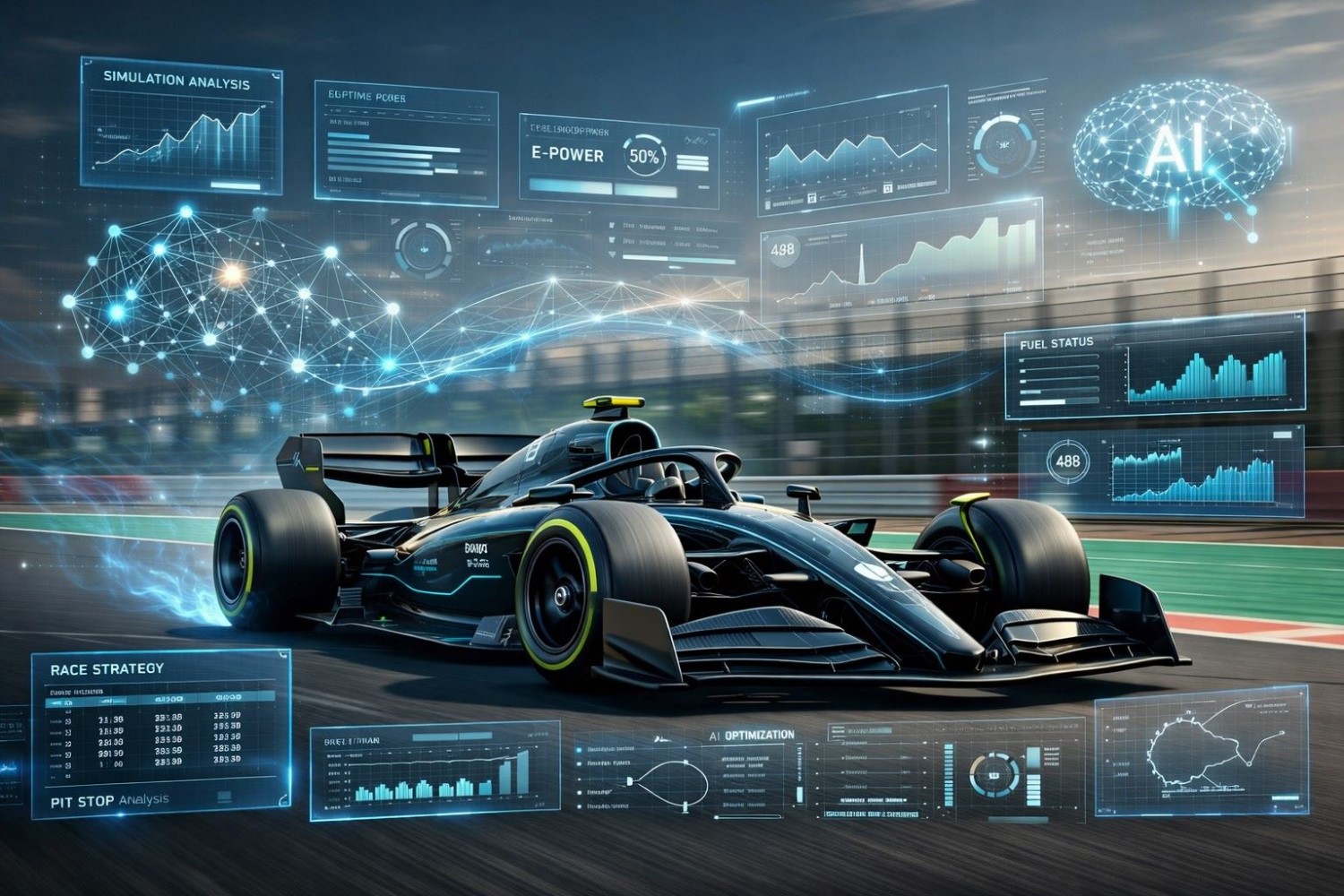
Artificial Intelligence (AI) in F1 – From, Design to Pit-Wall Strategy to Fan Experience
Formula 1 has always been a high-stakes engineering arms race, but the 2026 season marks a seismic shift. The sport’s most ambitious technical regulations in over a decade—featuring lighter, nimbler cars with active aerodynamics, a near 50/50 split between combustion and electric power, advanced sustainable fuels, and stricter cost caps—are forcing teams to rethink everything. Enter artificial intelligence (AI): no longer just a flashy sponsor logo on a rear wing, but a core strategist, designer, and even regulator.
–by Mark Cipolloni–
In the last six months alone, eight major AI partnerships have been inked across F1 and its 11 teams, with AI and machine-learning brands now ranking among the top new sponsorship investors.
This isn’t hype. It’s necessity. The 2026 cars will be shorter, narrower, and up to 30kg lighter, with reduced downforce and drag but movable front and rear wings that adapt in real time. Power units drop the MGU-H, triple electric output from the MGU-K, and emphasize energy recovery and deployment in ways never seen before. Physical wind-tunnel and track testing remain tightly limited under the budget cap. The winner? Teams that can simulate thousands of design iterations and race scenarios faster and smarter than their rivals—exactly where AI and machine learning shine.
The New AI Teammates: Who’s Partnering with Whom
AI sponsorship isn’t just branding anymore—it’s deep operational integration. Here’s how the grid is stacking up:
– Williams Racing made Anthropic’s Claude its “Official Thinking Partner,” with engineers reportedly embedded in the strategy room. The model isn’t just crunching numbers; it’s shaping race calls and development priorities for a team historically strong on innovation but hungry for an edge.
– McLaren has evolved its long-standing Google relationship into full Gemini deployment. Pre-race, the team now runs close to 300 million simulations, with generative AI suggesting optimal pit windows, tire strategies, and even real-time digital-twin updates via Dell’s trackside micro-datacentres.
– Red Bull Racing deepened its Oracle tie-up with agentic AI that moves beyond queries to proactive decision support on the pit wall—critical when energy management and active aero become lap-time kings.
– Mercedes added Meta AI to its toolkit alongside G42 predictive systems layered with SAP, while Ferrari leverages Amazon SageMaker for up to 60% faster CFD runs. Aston Martin tapped CoreWeave’s GPU cloud for its aerodynamics pipeline, and Racing Bulls uses Neural Concept’s machine-learning digital twins.
Even newcomers are jumping in: the incoming Cadillac F1 squad partnered with TWG AI to align people, data, and decisions from day one.
Not Just on the Car—AI Is Everywhere
The data deluge is staggering. 2026 cars will stream over a million data points per second across aero, mechanical, electrical, thermal, and driver inputs. AI turns that firehose into actionable insights: predictive tire wear, optimal energy deployment, even weather-adjusted strategies powered by partnerships like the FIA’s with Tomorrow.io.
On the regulatory side, the FIA is deploying computer-vision AI (ECAT) to police track limits with near-instant decisions, cutting human review by 95%. Formula 1’s own AWS-powered generative AI accelerates broadcast telemetry analysis and issue resolution. And for fans, Salesforce’s new “Your Tech Director” AI companion—built on Agentforce 360—explains the complex 2026 regs in plain language, making the sport more accessible than ever.
The Bigger Picture: A $3 Billion Sponsorship Boom and the Road Ahead
Technology sponsorship already topped $769 million last season (up 41%), helping push total F1 sponsorship past $3 billion in 2026. AI companies gain more than visibility: they get a public proving ground for high-stakes, real-world deployment in front of a tech-savvy global audience.
Yet challenges remain. Human intuition still matters—AI augments strategists; it doesn’t replace the gut feel honed over decades. Cost-cap rules raise questions about “in-kind” compute donations. And as more teams gain access, advantages may converge; the real differentiator will be proprietary models, deployment speed, and seamless human-AI collaboration.
Looking forward, 2026 could be the year underdogs close gaps if they leverage AI partnerships effectively. It also cements F1’s role as the ultimate tech showcase—mirroring how industries from aviation to autonomous vehicles are racing to integrate AI. The cars will still roar, drivers will still push limits, but the invisible race on screens and in the cloud may decide more championships than ever.
One thing is certain: in the 2026 F1 season, the fastest team won’t just have the best driver or chassis. It will have the smartest AI teammate on the grid. The race weekend has changed—and the sport is only accelerating.