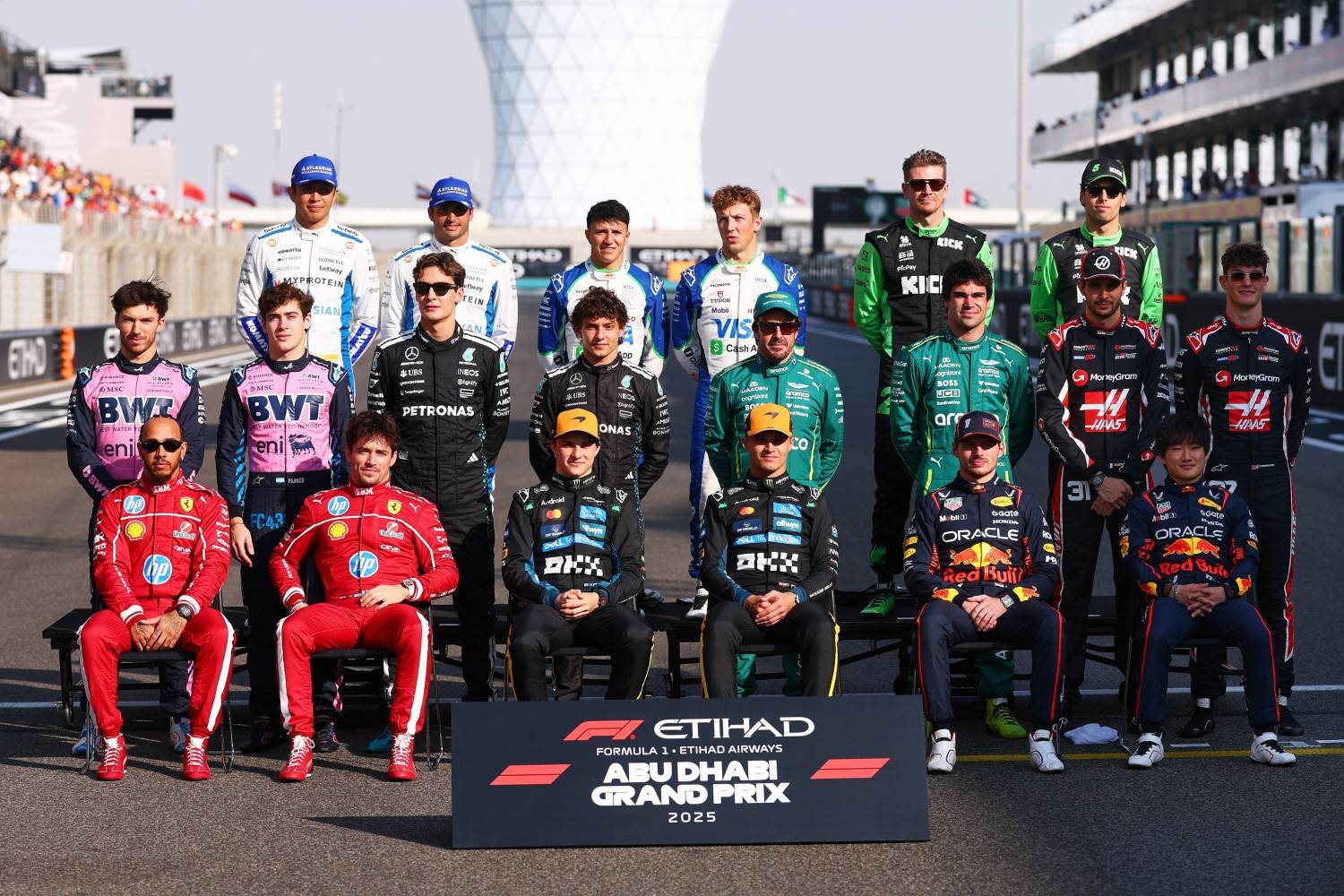
Formula 1 News: Driver Penalty Points at end of the 2025 season
As an update to our table before the 2025 Las Vegas GP, the following table lists all 2025 F1 drivers with their FIA super license penalty points as of the end of the 2025 season (after the Abu Dhabi Grand Prix). Drivers are sorted by total penalty points in descending order, with ties broken alphabetically by last name.
Below the table is an explanation of the penalty points system used in F1.
| Full Name | Team | Total Penalty Points | Penalty Details (with expiration dates) |
| Ollie Bearman | Haas | 10 | – One point: Change of direction while defending during the 2025 Abu Dhabi GP (expires December 7, 2026) – One point: Causing a collision with Liam Lawson at the 2025 Brazilian GP sprint (expires November 8, 2026) – Four points: Red Flag infringement in the pitlane during British GP (expires July 6, 2026) – Two points: Red Flag infringement in Monaco GP FP2 (expires May 23, 2026) – Two points: Causing a collision with Carlos Sainz at the 2025 Italian GP (expires September 7, 2026) |
| Yuki Tsunoda | Red Bull (reserve driver in 2026) | 8 | – One point: Change of direction while defending during the 2025 Abu Dhabi GP (expires December 7, 2026) – Two points: Causing a collision with Lance Stroll during the 2025 F1 Brazilian GP (expires November 9, 2026) – One point: Causing a collision with Ollie Bearman during the 2025 F1 British GP (expires July 6, 2026) – Two points: Causing a collision with Franco Colapinto during the 2025 F1 Austrian GP (expires June 29, 2026) – Two points: Overtaking under red flag conditions in the 2025 F1 Canadian GP (expires June 14, 2026) |
| Lance Stroll | Aston Martin | 6 | – One point: Change of direction while defending during the 2025 Abu Dhabi GP (expires December 7, 2026) – Two points: Causing a collision with Esteban Ocon at the US GP sprint (expires October 20, 2026) – Two points: Pushing another driver off track at the Canadian GP (expires June 15, 2026) – One point: Causing a collision with Charles Leclerc at the Monaco GP (expires May 25, 2026) |
| Liam Lawson | Racing Bulls | 6 | – One point: Driving erratically while defending during the 2025 Abu Dhabi GP (expires December 7, 2026) – One point: Causing a collision in the Brazilian GP (expires November 8, 2026) – One point: Causing a collision in the Miami GP (expires May 3, 2026) – Two points: Causing a collision in the Bahrain GP (expires April 14, 2026) – One point: Causing a collision in the Bahrain GP (expires April 14, 2026) |
| Kimi Antonelli | Mercedes | 5 | – Two points: Causing a collision with Charles Leclerc in the 2025 F1 Dutch GP (expires August 31, 2026) – Two points: Causing a collision with Max Verstappen in the 2025 F1 Austrian GP (expires June 29, 2026) – One point: Forcing another driver off the track at the 2025 F1 Italian GP (expires September 7, 2026) |
| Carlos Sainz Jr. | Ferrari | 4 | – Two points: Causing a collision with Kimi Antonelli in the US GP (expires October 20, 2026) – Two points: Causing a collision in the Bahrain GP (expires April 14, 2026) |
| Oscar Piastri | McLaren | 4 | – Two points: Causing a collision with Kimi Antonelli and Charles Leclerc at the 2025 Brazilian GP (expires November 9, 2026) – Two points: Erratic braking in front of Max Verstappen before a restart (expires July 6, 2026) |
| Alex Albon | Williams | 3 | – One point: Causing a collision with Lewis Hamilton at the Las Vegas GP (expires November 23, 2026) – Two points: Causing a collision with Franco Colapinto at the Azerbaijan GP (expires September 21, 2026) |
| Lewis Hamilton | Mercedes | 3 | – One point: Causing a collision with Franco Colapinto during the 2025 F1 Brazilian GP (expires November 1, 2026) – Two points: For failing to slow down under yellow flags during a reconnaissance lap prior to the 2025 Dutch Grand Prix (expires 31 August 2026) |
| Lando Norris | McLaren | 3 | (Details not specified beyond total; points accumulated during 2025 season) |
| Max Verstappen | Red Bull | 3 | – Three points: Causing a collision with George Russell during the 2025 F1 Spanish GP (expires June 1, 2026) |
| Gabriel Bortoleto | Sauber | 2 | – Two points: Causing a collision with Lance Stroll at the Las Vegas GP (expires November 23, 2026) |
| Pierre Gasly | Alpine | 2 | – Two points: Causing a collision with Carlos Sainz at the Hungarian GP (expires August 3, 2026) |
| Esteban Ocon | Alpine | 1 | – One point: Forcing Lance Stroll off the track at the 2025 Italian Grand Prix (expires September 7, 2026) |
| Franco Colapinto | Williams | 1 | – One point: Pushing a driver off the track in the 2025 F1 Austrian GP (expires June 29, 2026) |
| Charles Leclerc | Ferrari | 1 | – One point: Erratic driving while defending against George Russell in the F1 Hungarian GP (expires August 3, 2026) |
| Fernando Alonso | Aston Martin | 0 | No penalty points |
| George Russell | Mercedes | 0 | No penalty points |
| Isack Hadjar | Racing Bulls (moving to Red Bull) | 0 | No penalty points |
| Nico Hulkenberg | Sauber | 0 | No penalty points |
The Formula 1 penalty points system is a disciplinary measure managed by the FIA (Fédération Internationale de l’Automobile) to promote fair and safe driving. Introduced at the start of the 2014 season, it assigns points to a driver’s Super License for on-track and procedural infringements. The system helps deter reckless behavior without immediate race bans, allowing drivers to accumulate demerits over time. For 2025, the FIA has updated its Driving Standards and Penalty Guidelines (version 4.1) to enhance consistency, transparency, and steward decision-making, incorporating driver feedback from events like the 2024 Qatar Grand Prix.
How Points Are Awarded
– Issuance: Stewards award points based on the severity of the offence, as outlined in the FIA’s Penalty Guidelines, which cover around 100 potential infringements. Points are typically 1–5 per incident and are added to the driver’s Super License. They are not issued for minor penalties like reprimands or fines.
– Factors Considered: Stewards evaluate context, including intent, visibility, car handling, tire grip, and whether the action had sporting consequences (e.g., gaining a position). Mitigating factors (e.g., loss of control) may reduce points, while aggravating ones (e.g., recklessness) can increase them, though escalations are rare.
– Validity and Expiry: Points remain active for 12 months from the date of the incident (or session end, if applicable). They automatically expire after this period, potentially clearing a driver’s tally.
Consequences of Accumulating Points
– Threshold: If a driver reaches 12 or more points within any rolling 12-month period, their Super License is suspended, resulting in a ban from the next eligible event (typically one Grand Prix weekend).
– Post-Ban Reset: After serving the ban, 12 points are deducted from the driver’s total.
– Examples in Practice: Danish driver Kevin Magnussen was the first to trigger a ban in 2024, missing the Azerbaijan Grand Prix after reaching 12 points for repeated impeding incidents.
Common Infractions and Point Allocations
The 2025 guidelines provide a table of standard penalties, applied primarily during races unless specified. Here’s a selection of frequent examples:
| Infraction | Description | Typical Points | Additional Notes |
| Causing a collision | Intentionally or recklessly colliding with another car (International Sporting Code Appendix L, Chapter IV, Article 2(d)) | 3 (up to 4 if reckless) | 0–3 if no sporting impact; often paired with time penalties. |
| Forcing a driver off-track | Defending in a way that pushes another car beyond track limits (Article 2(b)) | 2 (up to 3 if reckless) | Must leave at least one car width; multiple direction changes to defend: 3 points. |
| Impeding dangerously | Blocking another driver who is gaining or lapping (Sporting Regulations Article 37.5) | 3 | Applies in qualifying or race; blue flags ignored: 1–2 points. |
| Failing to slow for yellow flags | Not reducing speed sufficiently under caution (Article 26.1) | 3 | Double yellows require significant slowdown. |
| Driving unnecessarily slowly | Endangering others, e.g., in qualifying cooldown (Article 33.4) | 3 | 3 points also for grid penalties in free practice/qualifying. |
| Overtaking under Safety Car | Passing more than two cars behind the SC (Article 55.8) | 3 | Drive-through penalty often added. |
| Exceeding Virtual Safety Car (VSC) speed | In 5+ red sectors (Article 56.5) | 3 | Drive-through for lesser breaches. |
| Ignoring black flag | Failure to pit as instructed (Appendix H, Article 2.5.4.1(d)) | 5 | Severe; disqualification possible. |
Broader Driving Standards Context
The system ties into F1’s Driving Standards Guidelines, which emphasize safe overtaking (e.g., inside line requires front axle alongside the mirror at apex; outside requires it ahead), rejoining the track without gaining advantage, and track limits (white lines are in-bounds; three strikes in a race lead to warnings, then 5-second penalties). These are non-binding but guide stewards for consistent rulings across sessions and circuits.