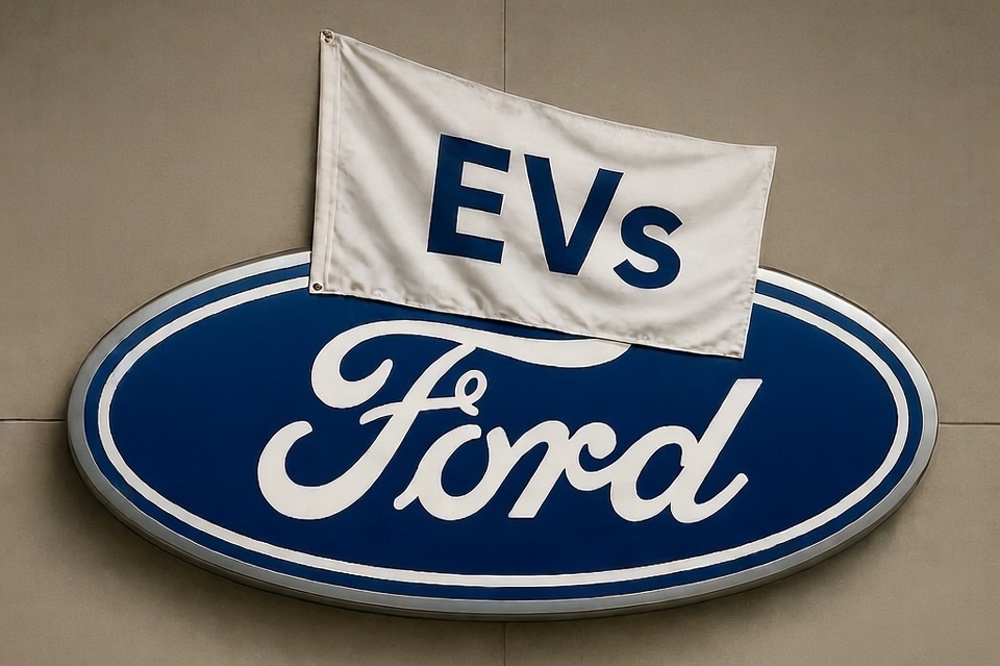
Automotive News: Ford Surrenders, admits EVs were a failure
On a crisp December morning in 2025, the automotive world woke to headlines that felt like an earthquake: Ford Motor Company, the iconic American giant, had just admitted defeat (note white flag of surrender) in the electric vehicle race it had once championed.
–by Mark Cipolloni–
CEO Jim Farley stood before reporters in Dearborn, his voice steady but his words carrying the weight of billions lost. “We’ve evaluated the market,” he said, “and we’re following customers to where it is today—not where we thought it was going to be.”
The numbers were brutal. Ford announced a staggering $19.5 billion writedown, the bulk tied to scrapping ambitious EV plans. At the heart of it: the all-electric F-150 Lightning, once hailed as the truck that would electrify America’s best-seller, was dead. Production had quietly ended earlier that fall, and no more pure-electric Lightnings would roll off the line.
In its place? An extended-range version—a hybrid with a gasoline generator to recharge the battery, promising over 700 miles of range. Factories built for EVs in Tennessee and Ohio were repurposed for gas and hybrid trucks. Battery plants shifted to energy storage for grids and data centers. The dream of a full EV transition, fueled by $30 billion in investments since 2021, lay in ruins.
Wall Street’s reaction? Ford’s stock jumped 2% in after-hours trading.
Read that again: The market celebrated surrender.
Traders saw clarity in the chaos—a legacy automaker finally admitting what consumers had been saying with their wallets: EVs weren’t ready for prime time, especially not big trucks that hauled, towed, and endured real work. The federal $7,500 tax credit had vanished under the new administration, demand slumped, and losses piled up—$5 billion a year in the EV division alone.
Across Detroit, whispers turned to plans. General Motors executives huddled, eyeing their own EV timelines. In Europe, mandates faced fresh scrutiny as governments reconsidered forcing the future.
But in California, one man watched with quiet vindication. Elon Musk, whose Tesla had weathered storms of skepticism, saw his moat widen. While legacies burned cash on subsidized dreams, Tesla had built profitability on demand—not mandates.
December 15, 2025, became a marker: the day a titan confessed that the “inevitable” EV transition was built on sand. Subsidies had bridged the gap temporarily, but technology and consumer reality never caught up.
Industries propped by policy crumble when policy shifts. Ford had bet the house on governments forcing change forever.
Consumers voted no.
Governments pivoted.
Ford retreated.
And the bill—$19.5 billion—was just the first installment.
In boardrooms worldwide, the reckoning had begun. The EV narrative, once unbreakable, had cracked wide open.