TV News: The Great Divide Between NASCAR and Formula 1 Fandom
In the high-octane world of motorsport, two giants dominate the landscape—but they rule over entirely different kingdoms. NASCAR reigns supreme in America, packing massive oval tracks with roaring crowds and delivering door-to-door racing that feels like homegrown thunder.
–by Mark Cipolloni–
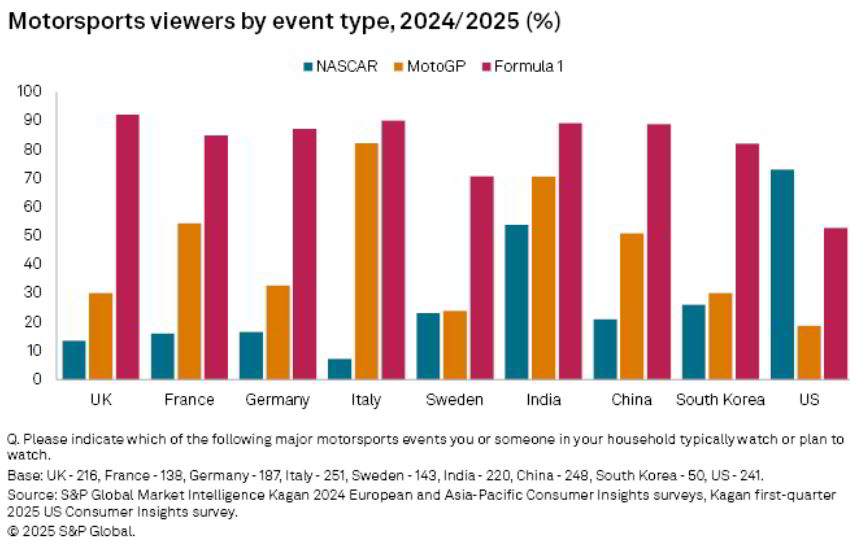
Across the Atlantic and beyond, Formula 1 captivates the globe with its glamorous circuits, cutting-edge technology, and international allure. A stunning new survey from S&P Global Market Intelligence lays bare this divide: roughly 75% of U.S. racing fans tune into NASCAR, while an overwhelming 90% of motorsport enthusiasts outside America follow Formula 1.
The data, drawn from surveys of internet-using adults across the U.S., Europe, and Asia, reveals motorsport’s uneven global footprint. In countries like Italy and China, a full 25% of respondents reported watching races from NASCAR, F1, or MotoGP in the past year. India and the UK followed closely at 22%, with Germany at 19%. Yet in the U.S., only 10% of adults said the same—highlighting how NASCAR’s grip on domestic fans contrasts sharply with F1’s international dominance.
Demographics tell an even starker story. American motorsport viewers skew older, with most over 55, fueling long-standing concerns about NASCAR’s aging fanbase. Internationally, F1 draws younger crowds—especially in emerging markets like China and India—who are more digitally engaged and diverse.
This isn’t just about who watches what; it’s reflected in the numbers across the board. Globally, F1 dwarfs NASCAR in reach and revenue. Recent estimates peg F1’s annual earnings at around $3.6 billion, compared to NASCAR’s roughly $425 million. Attendance follows suit: F1 events draw over six million fans yearly across exotic locales like Monaco and Silverstone, with single races like the British Grand Prix hitting 480,000. NASCAR’s flagship Daytona 500 caps at around 182,000, with total seasonal attendance in the 3-4 million range despite having far more races per year (36 vs. 24 for F1).
On social media, F1’s glamour shines brightest—its official Instagram boasts nearly 37 million followers, against NASCAR’s 4 million. Global search interest tells a similar tale: Formula 1 racks up about 40 million monthly queries worldwide (with the U.S. contributing just 6%), while NASCAR hovers around 3 million, 84% from America.
In the U.S., however, NASCAR holds the edge in TV viewership. Cup Series races average 2.8-2.9 million viewers domestically, outpacing F1’s 1.1-1.3 million on ESPN platforms. Head-to-head clashes often favor NASCAR, though F1 has notched wins on high-profile weekends like Miami.
Yet trends point to change. Boosted by Netflix’s Drive to Survive, three U.S. races, and a younger demographic, F1 is surging stateside—some projections even suggest it could overtake NASCAR in American popularity by the mid-2030s. NASCAR, meanwhile, fights to rejuvenate its base amid declining viewership in recent years.
This divide isn’t a flaw—it’s what makes motorsport thrilling. NASCAR embodies raw, accessible American grit: pack racing, close finishes, and fan proximity. F1 offers pinnacle engineering, global prestige, and star power from drivers like Max Verstappen and Lewis Hamilton. One thrives on home soil; the other conquers the world.
In the end, there’s room for both. Whether you’re tailgating at Daytona or sipping champagne in Monaco, the roar of engines unites fans across borders. But as data shows, the passion burns brightest in very different places.