Formula 1 News: Red Bull-Ford Power Unit: A New Era Begins in 2026
As Formula 1 heads into its dramatic 2026 regulation overhaul, Red Bull Racing is making history by becoming a full works team for the first time since entering the sport in 2005. After a highly successful partnership with Honda that delivered multiple championships, Red Bull established Red Bull Powertrains (RBPT) in 2021 to take control of its destiny.
Partnering with Ford—returning to F1 after decades away—the team is developing its own power unit, set to power both Red Bull Racing and its sister team, Racing Bulls (formerly AlphaTauri).
The 2026 rules mark a significant shift: power units will feature a roughly 50/50 split between internal combustion engine (ICE) power and electrical energy, running on fully sustainable fuels, with increased hybrid deployment and no MGU-H. This levels the playing field somewhat for newcomers like Red Bull-Ford and Audi, though established manufacturers like Mercedes, Ferrari, and Honda hold decades of hybrid expertise.
Early Impressions and Dyno Progress
Max Verstappen, Red Bull’s four-time world champion, has already heard the new engine fired up on the dyno. On the team’s Talking Bull podcast, he described it positively: “It sounded good… it sounded, like, crisp.” He jokingly added, “I’m not sure they actually develop on the noise, but it made a good noise. It’s not a V10.” While no public audio has been released (unlike Mercedes and Honda), Verstappen’s feedback suggests the unit has a promising tone under the new regs.
Ford Performance global director Mark Rushbrook provided an extensive update in a late-December 2025 interview, emphasizing that the program is firmly “on target.” He stated: “We are to plan, so where we need to be… When it comes to the timelines that were developed early-on in the program, we’ve been hitting those.” The development approach has been methodical: prioritizing power extraction, locking in reliability, then pushing performance further. Current efforts are centered on “the details of that calibration and the drivability,” including software refinement, which can be validated in simulators with drivers.
Rushbrook acknowledged the inherent uncertainty of a new power unit: “There’s always some level of nervousness or anticipation anytime there’s a new car or engine on track… Until you get it all together on an actual racetrack, you haven’t seen everything.” The critical milestone will be the closed-doors pre-season testing in Barcelona, where real-world validation begins.
On competitiveness, Rushbrook is pragmatic but optimistic. All manufacturers target the same theoretical performance ceiling under the laws of physics, but execution varies. He expects any internal combustion engine (ICE) deficit compared to veterans like Mercedes or Ferrari to be “only slight,” compensated by strengths elsewhere—particularly in the heavily boosted electrical side, where Ford’s expertise shines. “We’ve got a lot of experienced people that came in from other programs… So even if we’re a little bit behind with the combustion engine, we don’t think it’s going to be by much, and we’ll make up for it in everything else.”
Rushbrook also endorsed the 2026 regulations’ catch-up mechanisms (extra development allowances for lagging manufacturers), calling them “appropriate for the sport” to ensure competitiveness, distinct from Balance of Performance systems in other series.
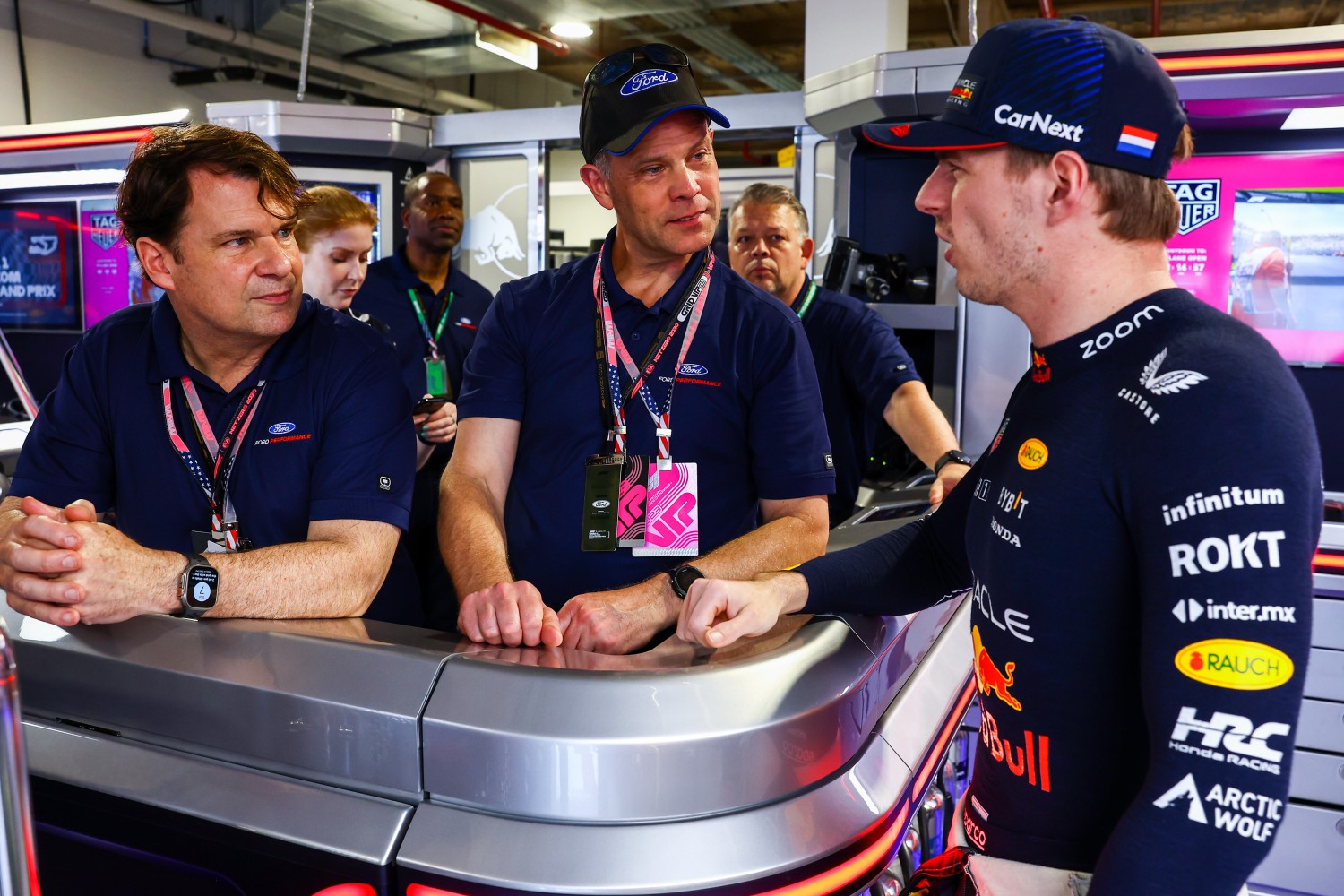
Team principal Laurent Mekies called the project “crazy” and a true “Red Bull challenge,” proudly partnering with Ford to take on giants with 90+ years of engine heritage.
Building a Powerhouse: The RBPT Division
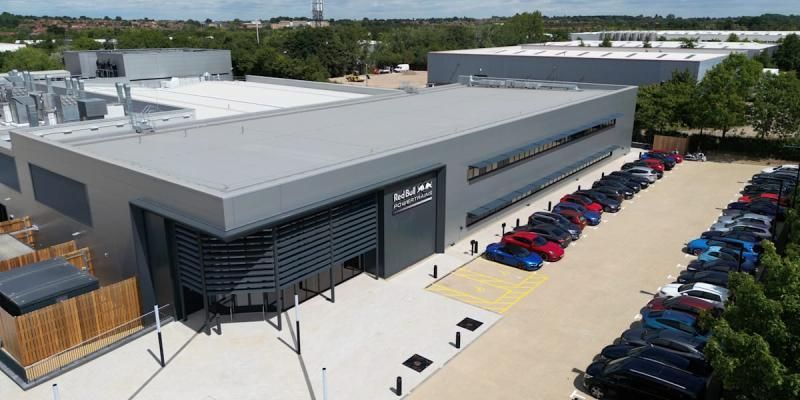
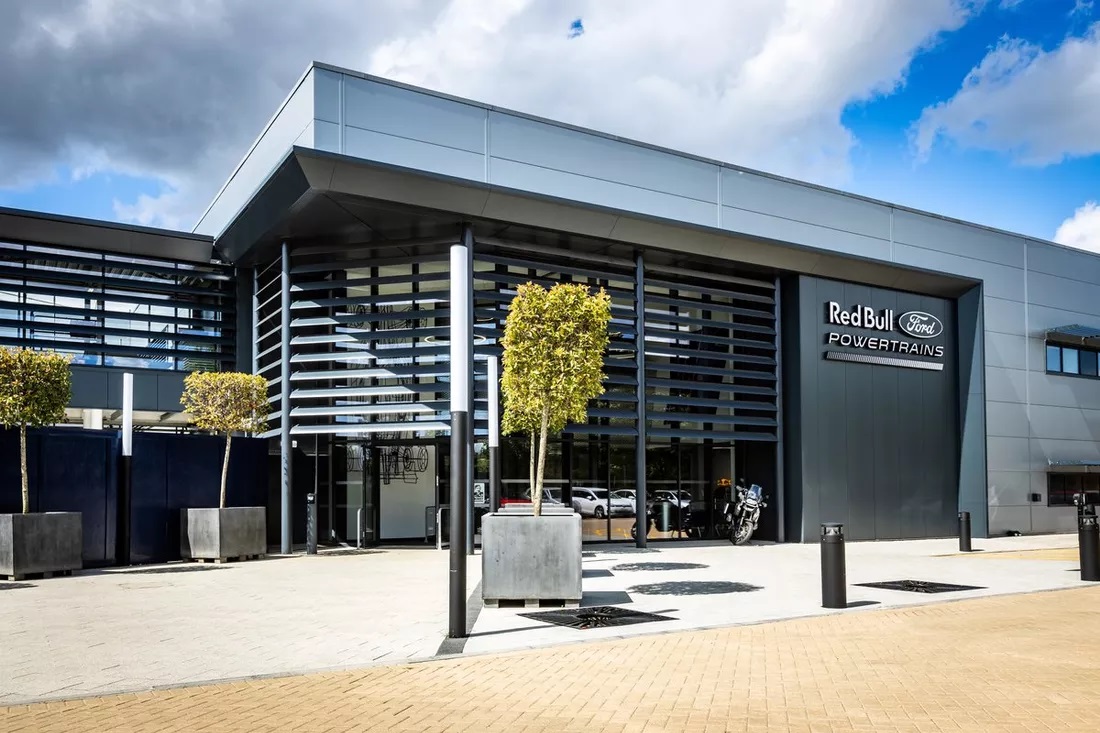
Red Bull’s ambition is underscored by the scale of RBPT. Recent reports indicate the division now employs 400 to 600 people, a massive operation based on the Milton Keynes campus alongside the chassis team—for seamless integration advantages over rivals like Mercedes (whose engine facility is separate – Brixworth engines, Brackley chassis). This growth started from taking over Honda’s program post-2021 and ramped up aggressively for the all-new 2026 design.
A key part of this buildup involved recruiting top talent, particularly from Mercedes High Performance Powertrains (HPP)—the benchmark of the current hybrid era. When Red Bull announced its in-house engine plans in 2021, it famously poached several senior Mercedes engineers, starting with Ben Hodgkinson as technical director (formerly Mercedes’ head of mechanical engineering). Additional high-profile hires followed, including roles in electronics, ERS, and ICE design.

Numbers have varied over the years: Early reports suggested Red Bull approached around 100 Mercedes staff, successfully hiring 15-50 key personnel initially. By 2024, Christian Horner claimed 220 from HPP had joined RBPT, though Toto Wolff countered it was closer to 19 senior engineers. Regardless of the exact figure, the influx of Mercedes expertise—combined with retained Honda knowledge and new graduates—has built a formidable team. Mekies highlighted this in late 2025: “We now have a building, we have the dynos, we have the 600 people.”
What to Expect in 2026?
The 2026 rules—50/50 ICE-electric split, no MGU-H, sustainable fuels, and boosted hybrid deployment—play to newcomers’ strengths by reducing the experience gap. Ford’s expanded role (now including turbo and ICE testing support beyond initial battery/electric focus) adds depth.
Optimism abounds within the camp. Verstappen’s manager, Raymond Vermeulen, said they’ve “heard good things about the engine,” while chief designer Pierre Waché called it “very, very promising.” Ford’s deeper involvement (beyond initial branding expectations) includes advanced manufacturing support, and the partnership has expanded into the electric portion of the Power Unit.
However, realism tempers the hype. Mekies warned it would be “naive” to expect dominance from day one, anticipating “very tough months” as a newcomer against seasoned players. No one knows the true pecking order until pre-season testing and the early races—energy management, drivability, and sustainable fuel efficiency will be decisive.
No one expects Red Bull-Ford to dominate immediately; early races could be challenging as calibration and energy management are optimized. However, with met benchmarks, a massive team, and regulatory concessions for catch-up, the unit is viewed internally as “very promising.” If it delivers competitive power and drivability from the outset, Verstappen could challenge for a fifth title. The true hierarchy reveals itself in testing and Australia 2026—but the signs from Milton Keynes are encouraging for Red Bull’s bold independence era.