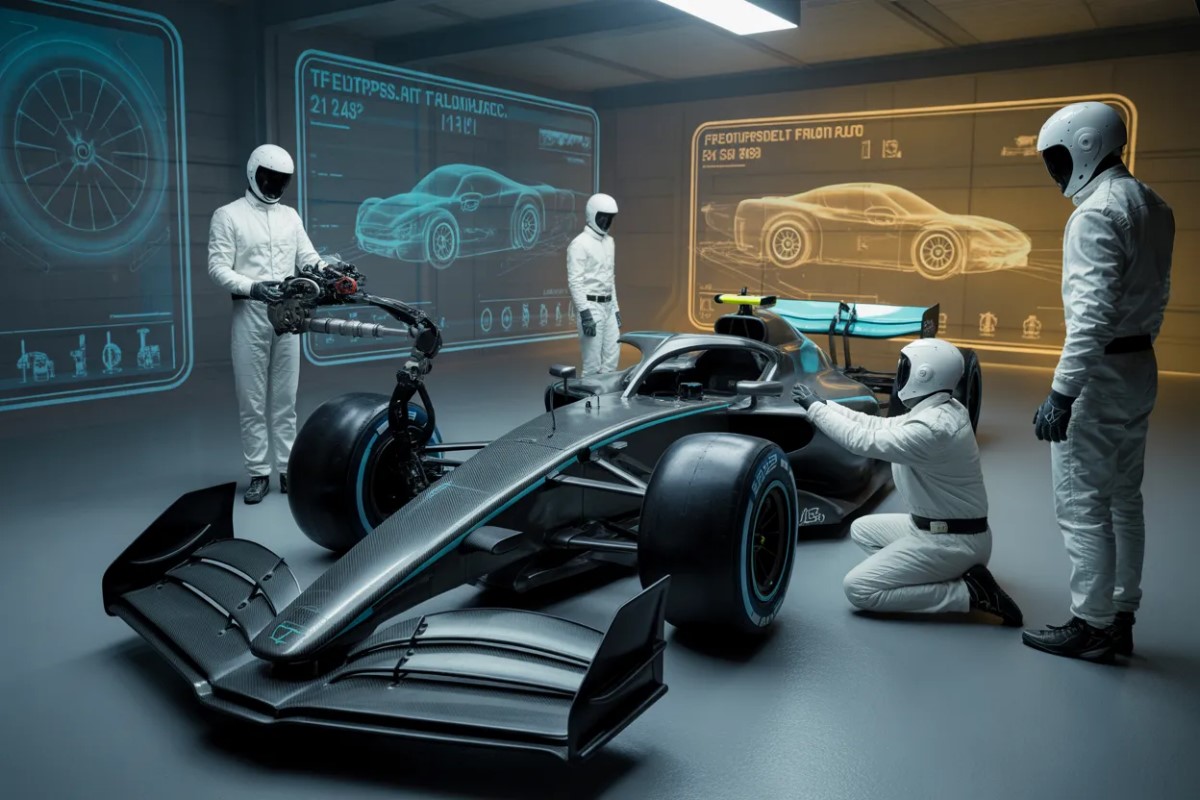
AI, Robotics, and Rapid Prototyping: How Intelligent Technology Is Transforming Automotive and Motorsports
Artificial intelligence (AI) and robotics are no longer experimental concepts inside the automotive and motorsports industries—they are becoming foundational tools. From Formula 1 strategy simulations to robotic manufacturing lines producing next-generation electric vehicles, intelligent machines are redefining how performance is designed, tested, and executed.
The Next Evolution of Speed and Engineering
Motorsports has always served as a laboratory for innovation. Technologies that once appeared only on race cars—advanced telemetry, lightweight materials, and hybrid power systems—eventually reached consumer vehicles. Today, AI-driven analytics, autonomous robotics, and digital engineering workflows are accelerating that transfer at an unprecedented pace.
The result is a shift from traditional trial-and-error engineering toward predictive development, where teams can model outcomes before a single physical component is built.
AI Strategy and the Data-Driven Race Weekend
Race teams now process millions of data points during a single event. Tire degradation patterns, fuel usage, weather modeling, and driver behavior are analyzed in real time by machine-learning systems that recommend strategy adjustments within seconds.
AI is also reshaping simulation. Digital twins—virtual replicas of cars—allow engineers to test aerodynamic updates, suspension geometry, and energy deployment strategies without expensive track time. This reduces cost while improving precision.
Beyond racing, automotive manufacturers are applying the same tools to safety testing, autonomous driving algorithms, and energy efficiency optimization. The boundary between racing innovation and everyday mobility continues to blur.
Robotics on the Factory Floor and in the Pit Lane
Robotics has quietly become one of the biggest drivers of performance consistency. Modern automotive production relies on collaborative robots capable of precision assembly at microscopic tolerances. These machines handle complex composite materials, battery modules, and structural components that demand repeatable accuracy.
Motorsports teams are exploring similar automation concepts. While pit stops remain human-led for speed and adaptability, robotics is increasingly used behind the scenes—preparing components, calibrating sensors, and supporting rapid rebuild cycles between sessions.
The key advantage is reliability. Intelligent robotic workflows reduce variability, allowing engineers to focus on innovation rather than basic production challenges.
Why Rapid Prototyping Is Now a Competitive Advantage
Perhaps the most important intersection of AI and robotics is rapid prototyping. Before committing to full manufacturing, teams can create functional prototypes that validate design assumptions. This shortens development cycles and reduces risk.
Additive manufacturing, commonly known as 3D printing, enables engineers to produce lightweight aerodynamic parts, cooling ducts, and structural elements within days instead of months. AI enhances this process by optimizing geometry for strength, airflow, and weight simultaneously.
Specialized providers help translate digital concepts into physical components quickly, enabling teams and manufacturers to iterate faster. Those interested in how professional additive workflows accelerate innovation can Learn more about advanced 3D printing solutions that support design validation, prototyping, and low-volume production across multiple industries.
This shift toward prototype-first engineering is becoming essential not only in motorsports but also in electric vehicle startups and performance automotive development.
Innovation Ecosystems Beyond Automotive
One of the most interesting developments is how research frameworks from other sectors influence automotive technology. Programs focused on digital transformation, sustainability, and data science often generate tools that later find applications in mobility and engineering.
Cross-sector innovation encourages knowledge transfer—machine learning techniques used in environmental monitoring can improve predictive maintenance, while robotics developed for agricultural automation can inform autonomous vehicle navigation.
Global research initiatives illustrate how interdisciplinary collaboration accelerates real-world impact. Projects exploring digital innovation, data governance, and applied science provide a foundation that industries like automotive can build upon. Readers interested in how research ecosystems drive technological adoption across sectors may want to Check this out to understand how structured innovation programs translate scientific advances into practical solutions.
This broader perspective highlights that the future of motorsports technology is not created in isolation; it is shaped by global research networks.
Software, Operating Systems, and Intelligent Engineering
As vehicles become software-defined machines, operating systems and development environments play a critical role. Engineers increasingly rely on secure, flexible platforms capable of running simulation tools, AI workloads, and legacy software simultaneously.
Virtualization and Linux-based environments are gaining traction because they allow teams to maintain compatibility while improving security and performance. This is particularly important when handling sensitive telemetry, proprietary algorithms, and remote collaboration workflows.
Flexible desktop ecosystems also enable engineers to experiment faster without hardware limitations. Those exploring alternative computing environments designed for productivity, privacy, and compatibility can Unlock the secrets behind platforms that allow seamless integration between different software ecosystems.
In a world where engineering is as much about code as hardware, software infrastructure becomes a competitive asset.
What the Future Looks Like
Looking ahead, AI and robotics will push automotive and motorsports into a new era defined by predictive engineering and semi-autonomous performance optimization. We can expect:
- AI-assisted vehicle setup recommendations
- Autonomous testing environments
- Generative design producing components humans would never conceive
- Fully digital development pipelines from concept to production
- Increased sustainability through optimized materials and energy usage
Motorsports will continue to act as the proving ground. Technologies validated under extreme performance conditions will gradually reach consumer vehicles, shaping how people drive, maintain, and interact with cars.
The convergence of AI, robotics, and rapid prototyping suggests that speed is no longer measured only on track — it is measured in how quickly ideas become reality.
For teams, manufacturers, and technology providers, the message is clear: intelligent development is not optional. It is the new baseline for innovation in automotive and racing alike.