Formula 1 News: We preview with 2026 Japanese GP at Suzuka
We preview this weekend’s Japanese GP Formula 1 race at the historic 3.61-mile long Suzuka circuit, owned by Honda.
–by Mark Cipolloni–
Suzuka stands as one of the most spectacular and demanding circuits on the F1 calendar. It remains the only track with a true figure-of-eight layout, weaving through the rolling hills of Mie Prefecture. Honda’s Suzuka factory, built in 1960, sits right next door — a fitting home for one of motorsport’s greatest challenges.
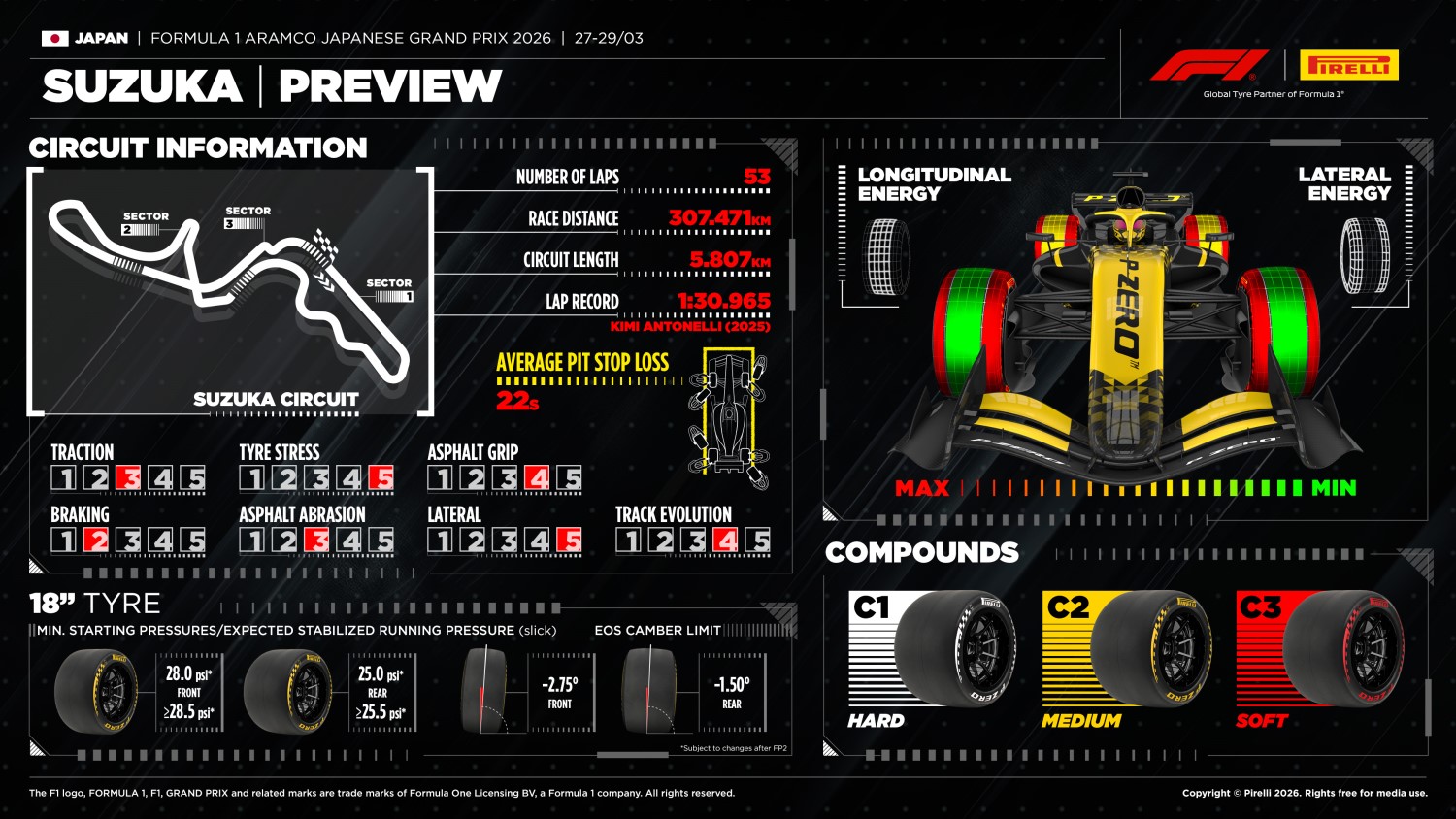
The 18-corner layout tests car and driver like few others. Iconic sections such as the Esses, the ultra-fast 130R, and the technical Spoon Curve have barely changed in decades, preserving the circuit’s raw character. High-speed sweeps, rapid direction changes, heavy braking zones, and a tight chicane with aggressive curbs make Suzuka the ultimate all-in-one test. Pirelli has brought its hardest compounds (C1 Hard, C2 Medium, C3 Soft) — the perfect match for this high-energy track. Roughly 50% of the surface was resurfaced ahead of last year’s event, with further work completed this season up to Turn 17, promising lower grip and evolving conditions.
Universally loved by drivers, Suzuka carves through undulating Japanese countryside with long high-speed sections and lightning-quick direction changes. Tiny mistakes are punished instantly by grass, gravel, and unforgiving barriers. A strong aerodynamic package and total driver confidence are essential, while the high lateral loads make tire management critical. Grid position matters more than usual — clear air is gold on this narrow, overtaking-challenged layout.
This weekend also marks the peak of cherry blossom (Sakura) season, painting the circuit in stunning pink. It’s only the second time the Japanese Grand Prix has been held in early spring; the first Pacific Grand Prix ran at Aida in April 1994 before the event settled into its traditional October slot until the 2024 shift. Expect cooler temperatures than usual in Japan, with averages between 8°C and 13°C.
Japan first hosted F1 at Fuji Speedway in 1976 — famous for the Hunt-Lauda title showdown — but disappeared from the calendar for a decade. When it returned in 1987, it landed at Suzuka, where it has stayed ever since. The circuit has crowned multiple world champions, often after dramatic collisions, and Max Verstappen became the latest when he sealed the 2022 title here. This will be the final Suzuka race in the current spring slot for some time as the calendar continues to evolve.
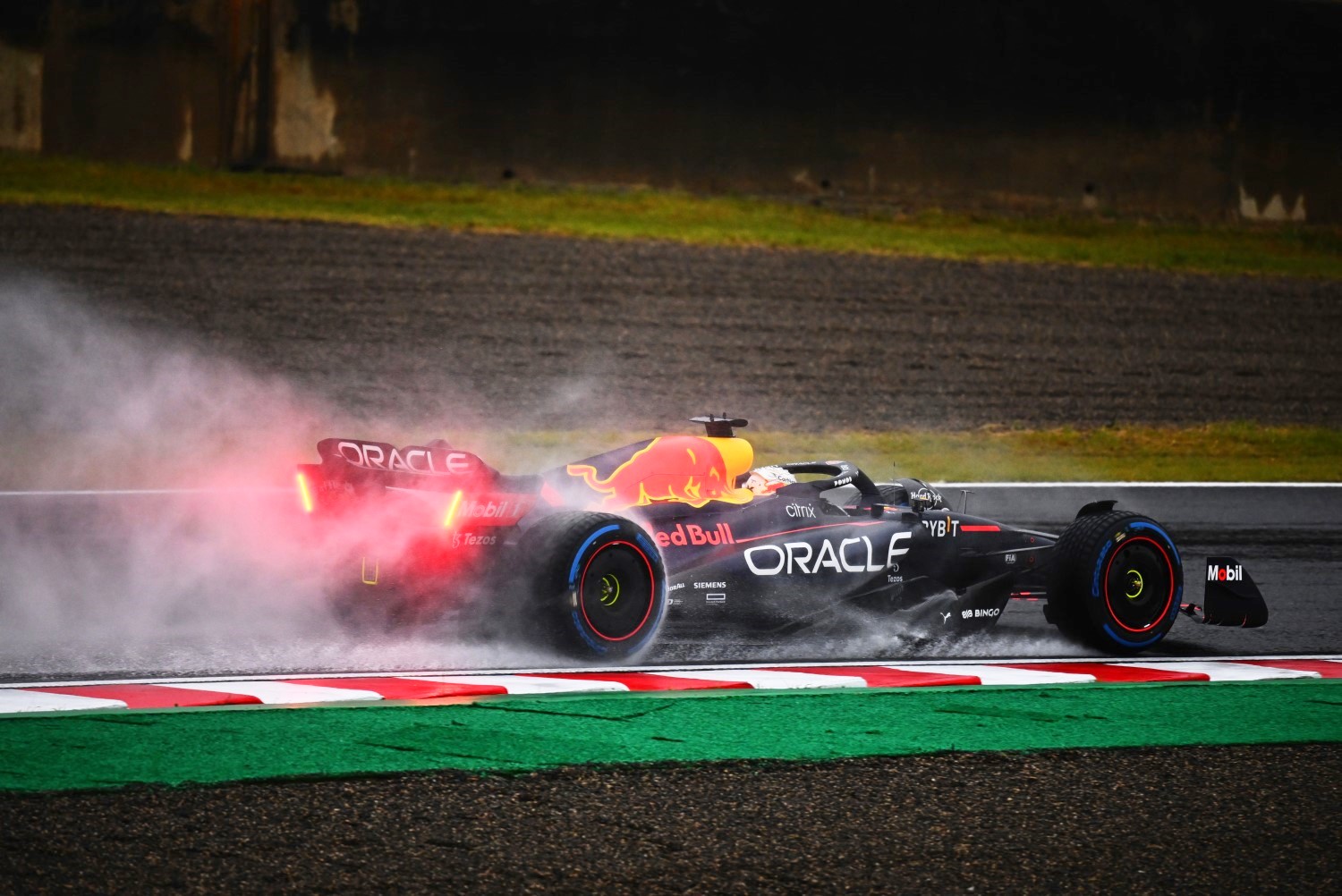
Ask any driver, and Suzuka sits near the top of their favorite tracks. The lap begins with a high-speed right-hander into the flowing Esses, then plunges through Degner 1 and 2, Spoon Curve, and the breathtaking 130R. The hairpin and final chicane demand precision, while the proximity of the barriers keeps every lap on a knife-edge. Torrential rain and typhoons have disrupted proceedings before — qualifying was moved to Sunday morning in 2004, 2010, and 2019, and the 2022 race was shortened to just 28 laps because of persistent heavy rain.
With an average speed of 240 km/h (153 mph), Suzuka remains one of F1’s quickest and most exhilarating venues. Drivers barely breathe from start to finish, walking a tightrope at the limit. The first sector’s Esses rise and fall in rapid succession, while Spoon and 130R demand total commitment. A unique flyover adds to the spectacle: cars pass under the entry to 130R as they exit Degner 2.
Overtaking isn’t easy, but the racing is always thrilling once drivers find their rhythm through the Esses. Lap times improve dramatically once that flow clicks.
Japan initially joined Formula 1’s schedule at Fuji Speedway in 1976, a race made famous for the title showdown between James Hunt and Niki Lauda, but after its second year the country was absent for a decade. When Formula 1 eventually returned to Japan, in 1987, it did so at the demanding figure-of-eight Suzuka Circuit.
Its placement in the calendar means Suzuka has been the scene for the crowing of several world champions, some after high-profile collisions, while Max Verstappen became the latest world champion to secure a title at Suzuka, in 2022. It will be the last Suzuka race to take place in the fall for some time with the event due to shift to spring from 2024.
Speak to any Formula 1 driver, and they will immediately place Suzuka among their favorite racetracks. The drivers cascade into the high-speed right-hander at turn 1 before plunging immediately into a sequence of Esses, undulating through the scenery with rapid changes of direction. Fast corners such as Degner 1 and Degner 2, Spoon Curve and 130R require inch-perfect precision, while more technical turns including the hairpin and chicane are also deceptively tricky. The close proximity of grass, gravel and unforgiving barriers means even minor errors can be heavily punished.
Torrential rain and typhoons can even interrupt proceedings at Suzuka. On three occasions (2004, 2010, 2019) qualifying was moved to Sunday morning following the threat of a typhoon, while in 2022 the race was shortened with only 28 of 53 scheduled laps completed due to persistent heavy rainfall.
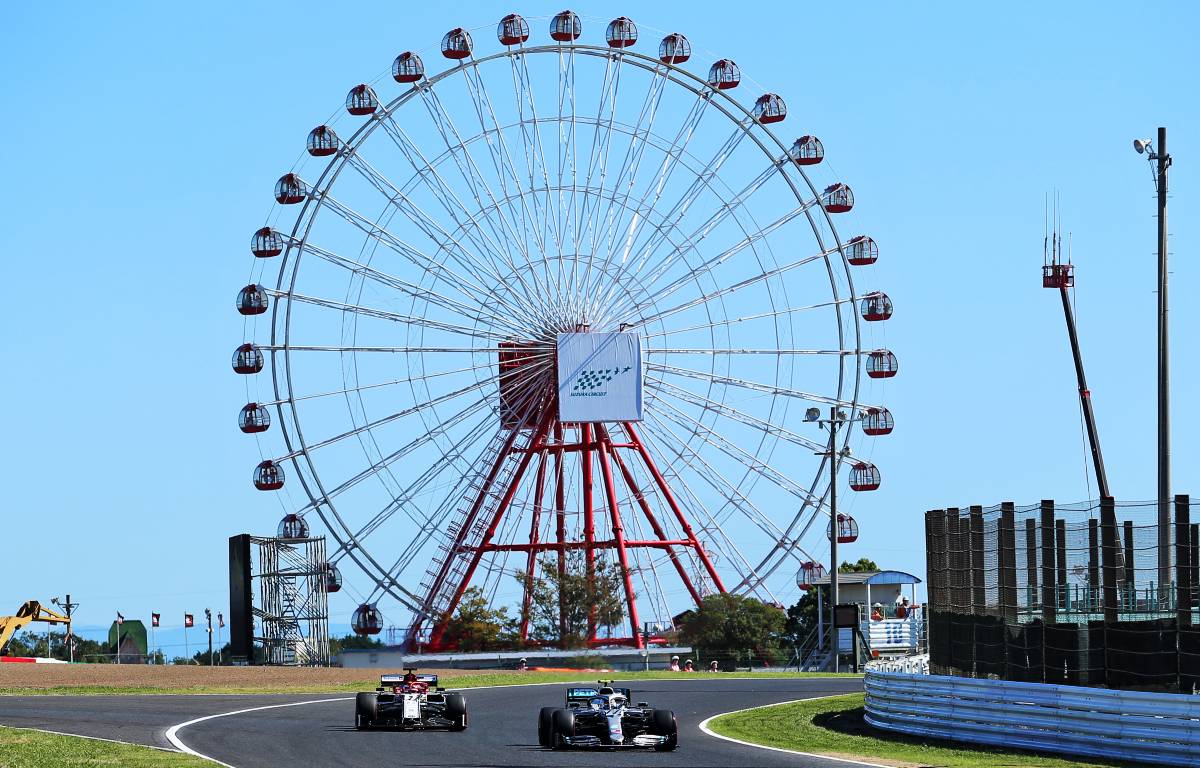
With an average speed of 153mph (240km/h), Suzuka is one of the quickest tracks on the F1 calendar.
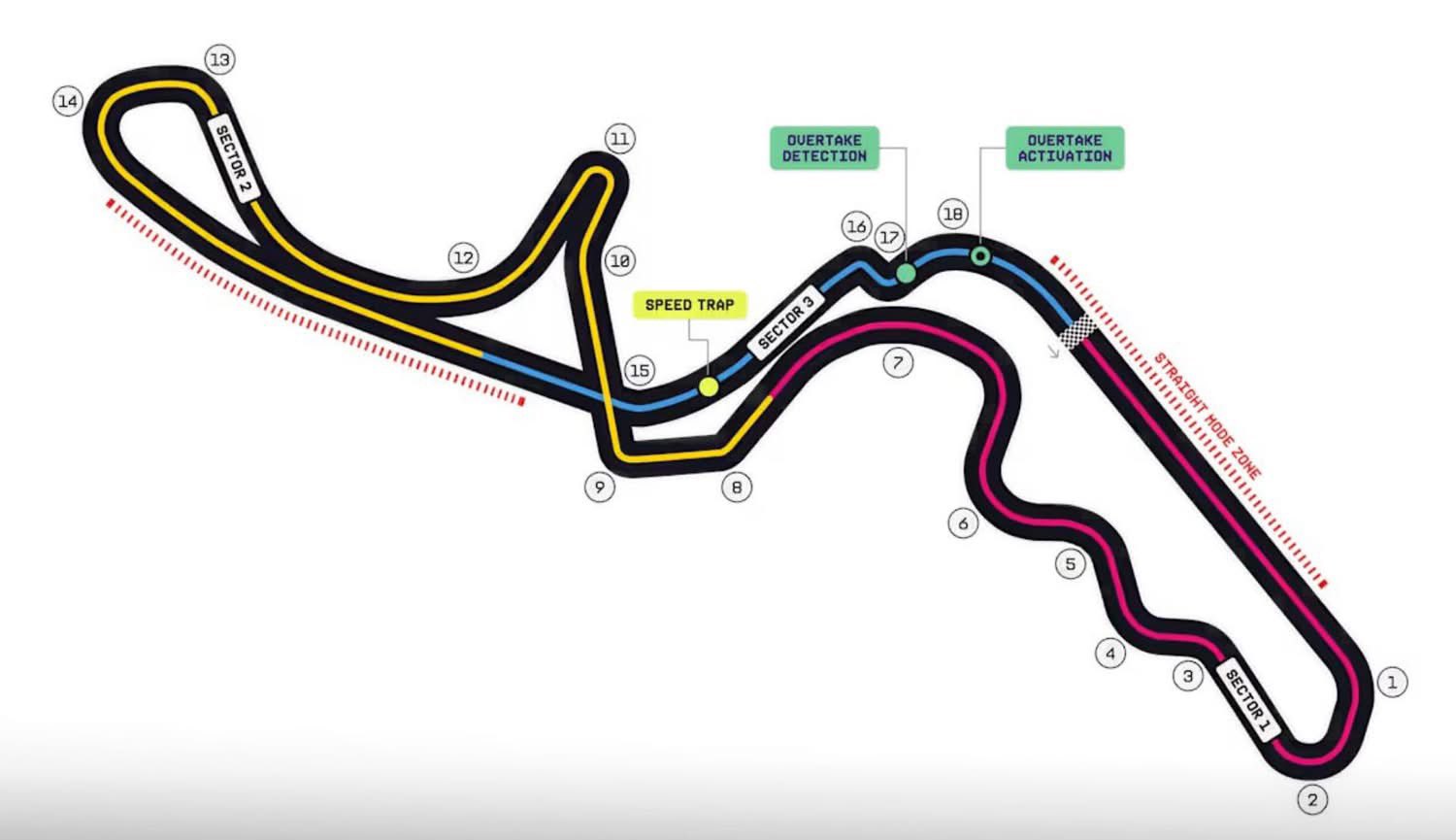
Suzuka is revered throughout the world as one of motorsport’s finest permanent circuits, with drivers barely having time to breathe through the lap, as they walk a tightrope while pushing their machines to the limit. The first sector is dominated by the Esses, a sequence of narrow sweeping medium- and high-speed corners that rise and plummet, while corners such as Spoon and 130R require total commitment.
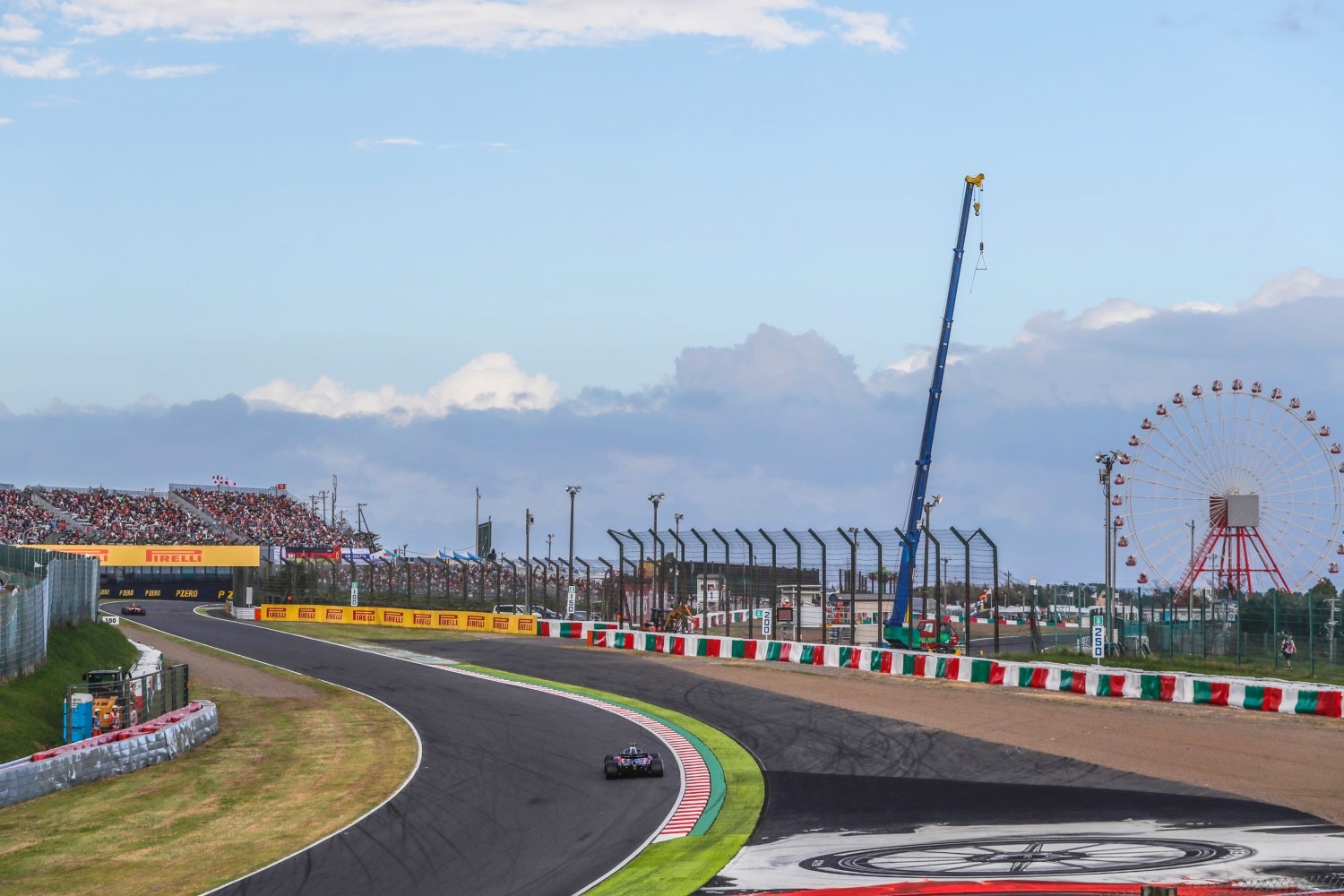
The peril is enhanced by the proximity of the grass, gravel traps and barriers, meaning mistakes are regularly punished. Suzuka is also the only circuit on the calendar to feature a flyover, with drivers passing underneath the entry to 130R as they negotiate the exit of Degner 2.
Overtaking is not easy in Suzuka but it is possible and the racing is always good here. The drivers will need to quickly find a rhythm, especially through the Esses, but once they have that, the lap time can improve very quickly.
A little history…..The Degner Story
Among Suzuka’s 18 corners, Spoon, 130R, and the uphill Turns 2-7 are world-famous. Less celebrated — but equally significant — are Turns 8 and 9, named after Ernest Degner, the German motorcycle racer who helped put Japanese bikes on the global map.
Born in 1931 in Gleiwitz (now Poland), Degner rose to prominence racing MZ two-stroke machines designed by Walter Kaaden, a brilliant engineer with a shadowy past at Peenemünde during World War II. In 1960, Suzuki’s first international outing at the Isle of Man TT was a disaster — 15 minutes off the pace. A chance meeting the following year between Degner and Suzuki president Shunzo Suzuki changed everything. Degner, fed up with life in East Germany and constant Stasi surveillance, agreed to defect and help develop Suzuki’s machines.
With the Berlin Wall newly erected, smuggling his family out required ingenuity. During the 1961 Swedish Grand Prix weekend, a friend hid them in a secret compartment in a Lincoln Mercury’s boot while the Stasi focused on Degner at the track. He retired early with engine failure, fled to West Germany, and reunited with his family before settling in Hamamatsu at Suzuki’s headquarters. MZ promptly cancelled its overseas racing program.
Degner won Suzuki’s first world title in the 50cc class in 1962 — despite living in constant fear of Stasi reprisals. Tragedy struck the following year at Suzuka when he crashed at what is now the Degner Curves; his fuel tank exploded and he suffered horrific burns requiring more than 50 skin grafts. He returned in 1964 but was plagued by further accidents and retired in 1966. Chronic pain led to morphine addiction. Degner died in 1983 at just 51; the official cause was a heart attack, but many suspected overdose or even foul play. Either way, Suzuka’s Degner Curves remain a lasting tribute to his pivotal role in Japanese motorcycle history.
Last Year’s 2025 Japanese GP
Defending champion Max Verstappen delivered one of the drives of the season, holding off the faster McLarens of Lando Norris and Oscar Piastri to win the 2025 Japanese Grand Prix at Suzuka. Starting from pole in the inferior Red Bull-Honda, Verstappen never put a wheel wrong and beat Norris by just 1.423 seconds — claiming a record fourth consecutive Japanese GP victory and breaking his tie with Michael Schumacher for the most successive wins here.
Lap after lap, the top three pulled clear. As the race wore on, all three drivers traded personal-best sectors, but Verstappen matched every challenge from behind, keeping the gap between 1.1 and 2.5 seconds for the entire 53 laps. It was a masterclass in defense on the purest driver’s circuit in the world.
Related Video: Watch Qualifying Video
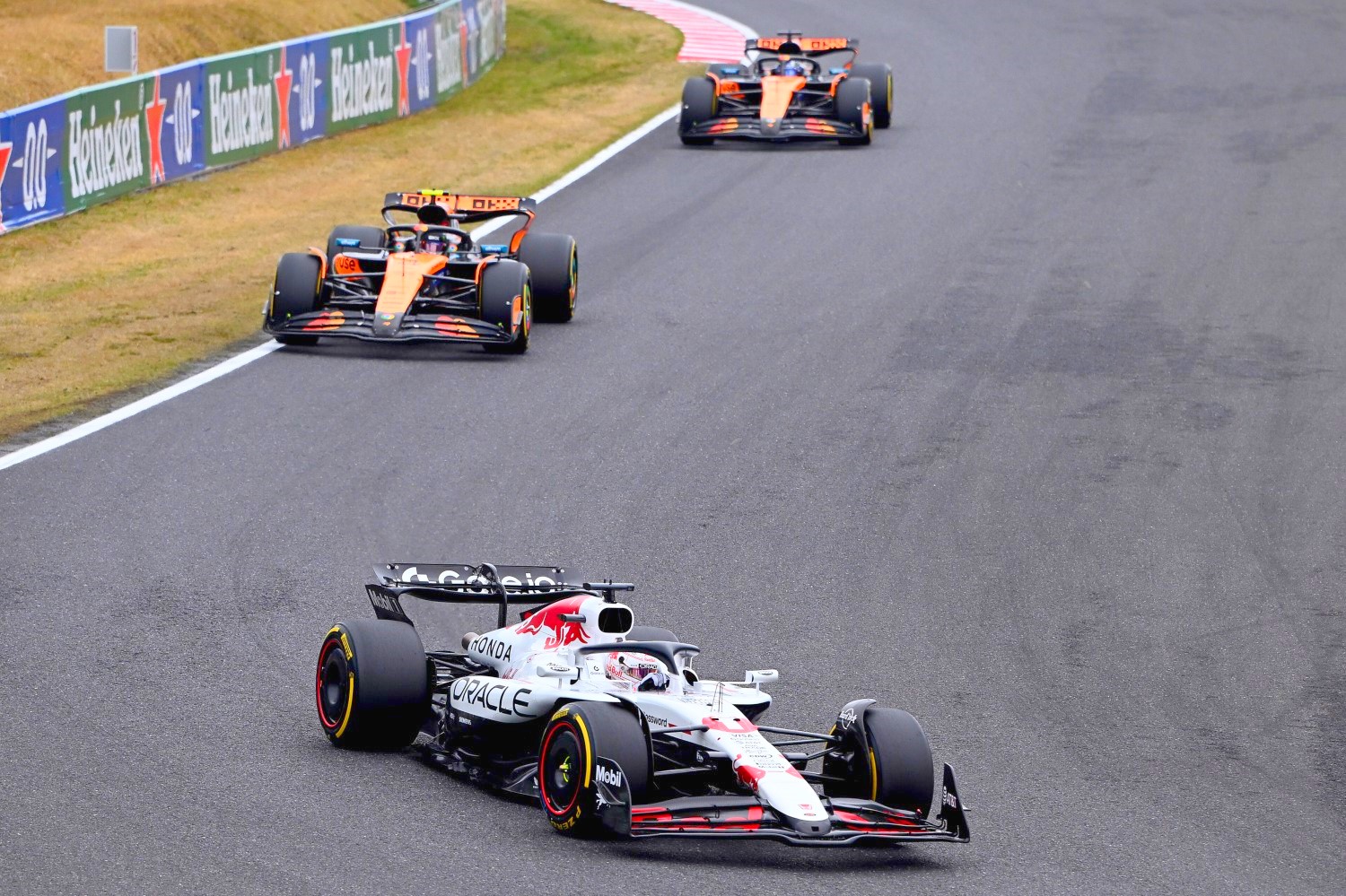
Max Verstappen of the Netherlands driving the (1) Oracle Red Bull Racing RB21 leads Lando Norris of Great Britain driving the (4) McLaren MCL39 Mercedes and Oscar Piastri of Australia driving the (81) McLaren MCL39 Mercedes on track during the F1 Grand Prix of Japan at Suzuka Circuit on April 06, 2025 in Suzuka, Japan. (Photo by Clive Mason/Getty Images) // Getty Images / Red Bull Content Pool //
Unlocking the Lap
The lap starts with the snaking Esses — a flowing, rewarding challenge where perfect entry and exit are everything. Little respite follows: the Degner section arrives immediately. Degner 1 is fast with a tight exit that’s easy to run wide; Degner 2 is slightly banked but equally unforgiving. Then comes the double-apex left-hander Spoon Curve, vital for lap time. Drivers must resist the urge to accelerate too early or risk running out of road before the second apex. It leads onto the longest flat-out blast to 130R — slightly off-camber and easy to misjudge.
Fact File: Japanese Grand Prix
– Only figure-of-eight circuit on the F1 calendar.
– Runs both clockwise and anti-clockwise thanks to the flyover after Degner 2.
– Balanced corner directions (10 right-handers, 8 left-handers) help even out tire wear.
– Turn 1 requires no braking on entry; drivers hit the brakes at nearly 5G while cornering.
– Steering wheel is almost constantly moving for nearly 2 km through the first sector.
– Only 1.2 km of the lap is spent in a straight line; most of the 5.807 km involves lateral G-forces.
– Just one DRS zone (between Turns 18 and 1) — one of only four such circuits.
– 130R is taken flat-out at 295 km/h; Turn 11 hairpin is the slowest at 60 km/h.
– Braking for Turn 11 is brutal — drivers brake while still cornering at 3.5G through Turn 10.
– One of the highest mass-sensitivity tracks of the season — extra fuel hurts lap time more than usual.
– Has hosted the season finale six times and was a late-season staple until 2022.
– Now an early-season fixture during cherry blossom season.
Weather Forecast
Friday is expected to be cloudy, with a temperature of 17°C, according to Weather.com. There is a 7% chance of rain, and winds could reach 10-15 kph on the first day.
USA TV Times
All Times Eastern
| Thursday, March 26, 2026 | Location | TV Times | Network |
| Formula 1 Japanese Grand Prix Weekend Warmup | Suzuka | 3:30am (Live Stream) | AppleTV |
| Formula 1 Japanese Grand Prix Practice 1 | Suzuka | 10:00pm (Live Stream) | Sky Sports via AppleTV |
| Formula 1 Japanese Grand Prix Practice 1 | Suzuka | 10:10pm (Live Stream) | AppleTV |
| Friday, March 27, 2026 | Location | TV Times | Network |
| Formula 1 Japanese Grand Prix Practice 2 | Suzuka | 1:40am (Live Stream) | AppleTV |
| Formula 1 Japanese Grand Prix Practice 2 | Suzuka | 1:45am (Live Stream) | Sky Sports via AppleTV |
| Formula 1 Japanese Grand Prix Practice 3 | Suzuka | 10:15pm (Live Stream) | Sky Sports via AppleTV |
| Formula 1 Japanese Grand Prix Practice 3 | Suzuka | 10:30pm (Live Stream) | AppleTV |
| Saturday, March 28, 2026 | Location | TV Times | Network |
| Formula 1 Japanese Grand Prix Qualifying | Suzuka | 1:00am (Live Stream) | Sky Sports via AppleTV |
| Formula 1 Japanese Grand Prix Qualifying | Suzuka | 2:00am (Live Stream) | AppleTV |
| Formula 1 Japanese Grand Prix Pre-Race | Suzuka | 11:30pm (Live Stream) | Sky Sports via AppleTV |
| Formula 1 Japanese Grand Prix Pre-Race | Suzuka | 11:50pm (Live Stream) | AppleTV |
| Sunday, March 29, 2026 | Location | TV Times | Network |
| Formula 1 Japanese Grand Prix | Suzuka | 1:00am (Live Stream) | AppleTV |
Which drivers have won the Japanese Grand Prix?
There have been 18 different winners of the Japanese Grand Prix since 1987 with Michael Schumacher being the most successful of them. Mario Andretti won the inaugural race hosted in 1976 at the Fuji circuit, while Gerhard Berger was the first victor at Suzuka.
Of the drivers currently on the grid, four have won there, including Hamilton, Valtteri Bottas, Max Verstappen and Fernando Alonso.
Hamilton (five), Verstappen (four) and Alonso (two) have all won multiple times there.
The last 16 winners of the Japanese Grand Prix:
2010 – Sebastian Vettel
2011 – Jenson Button
2012 – Sebastian Vettel
2013 – Sebastian Vettel
2014 – Lewis Hamilton
2015 – Lewis Hamilton
2016 – Nico Rosberg
2017 – Lewis Hamilton
2018 – Lewis Hamilton
2019 – Valtteri Bottas
2020 – Cancelled – Covid
2021 – Cancelled – Covid
2022 – Max Verstappen
2023 – Max Verstappen
2024 – Max Verstappen
2025 – Max Verstappen
Pirelli Tires
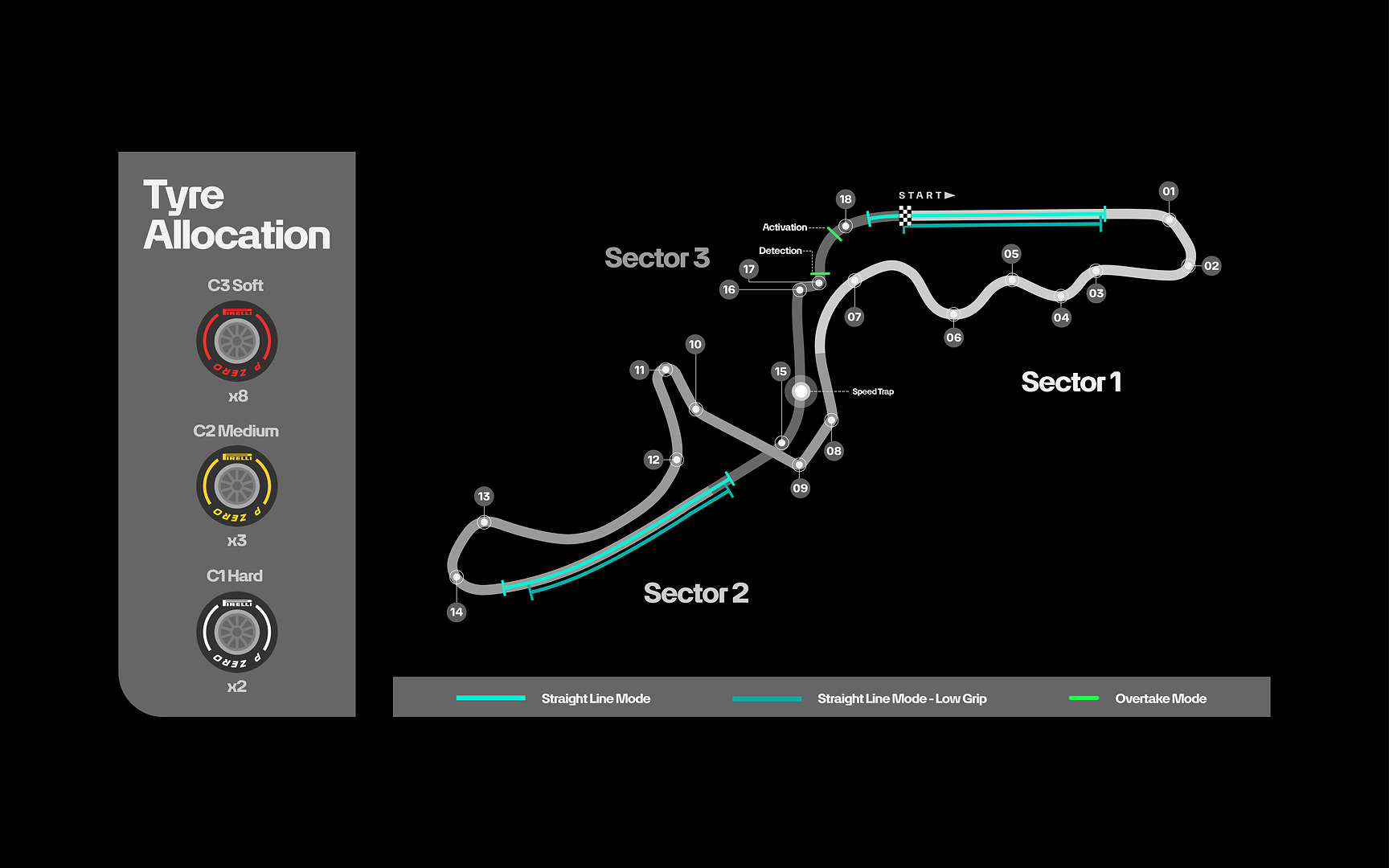
The forces and loads generated by the continuous changes of direction, combined with high speed sections, make the 5.807kilometer Japanese track one of the toughest for tires. The compounds selected are therefore the three hardest in the range: C1 for the Hard, C2 for the Mediums and C3 for the Soft. This means the hardest option, C1, will make its debut in Suzuka, having not been chosen for the first two race weekends of the season.
Williams engineer Previews Japanese GP Factors
Ahead of the 2026 Japanese Grand Prix, Paul Williams, Chief Trackside Engineer shares insights into the key technical factors that will shape the weekend.
What are the key technical challenges of Suzuka?
- Suzuka features a unique figure-of-eight configuration with several iconic corners. It is a fast, flowing circuit with significant high-speed corner content and frequent changes of direction.
- Overtaking can be difficult, as Turns 1 and 2 are narrow and the start/finish straight is relatively short.
- Since our last visit, the west course section of the track (Turns 7 to 17) has been completely resurfaced, complementing the work completed on the east course last year. Understanding the grip level of the newly laid surface will be a key focus across the weekend.
- With the late March event timing, the weather is expected to be cool. Fair conditions are forecast for Friday, however the outlook for Saturday and Sunday is currently more uncertain, with the possibility of rain showers passing through.
How do the 2026 regulations influence the approach this weekend?
- The new regulations define only two straight-line mode (SLM) zones; the start/finish straight and the run between Turns 14 and 15, both of which are active in wet and dry conditions.
- The lack of SLM into Turns 13 and 16 will require careful front ride height settings to ensure compliance with front skid wear requirements.
- A high level of super clipping is expected in Suzuka in both low and high-fuel conditions, due to the very fast, flowing nature of the circuit and the resulting low cornering times. As a result, we may see teams using lift and coast to help manage the energy challenge.
What are the tire challenges at Suzuka?
- Pirelli have prescribed the hardest compounds, which are well suited to the high-energy demands of the circuit.
- It will be important to understand the impact of the resurfacing, coupled with the cool conditions on tire performance.
- Graining is not anticipated to be a significant issue and is expected to be considerably less prevalent than in Shanghai.
What are the strategic considerations for the race?
- The Grand Prix is expected to be a one-stop race, with either the soft or medium tire a viable option for the start.
- At present, a two-stop strategy does not look favorable, with a significant shift in degradation or reduction in tire life required for the field to increase the number of stops.