Formula 1 News: Why Verstappen Is Dead Serious About Walking Away After 2026?
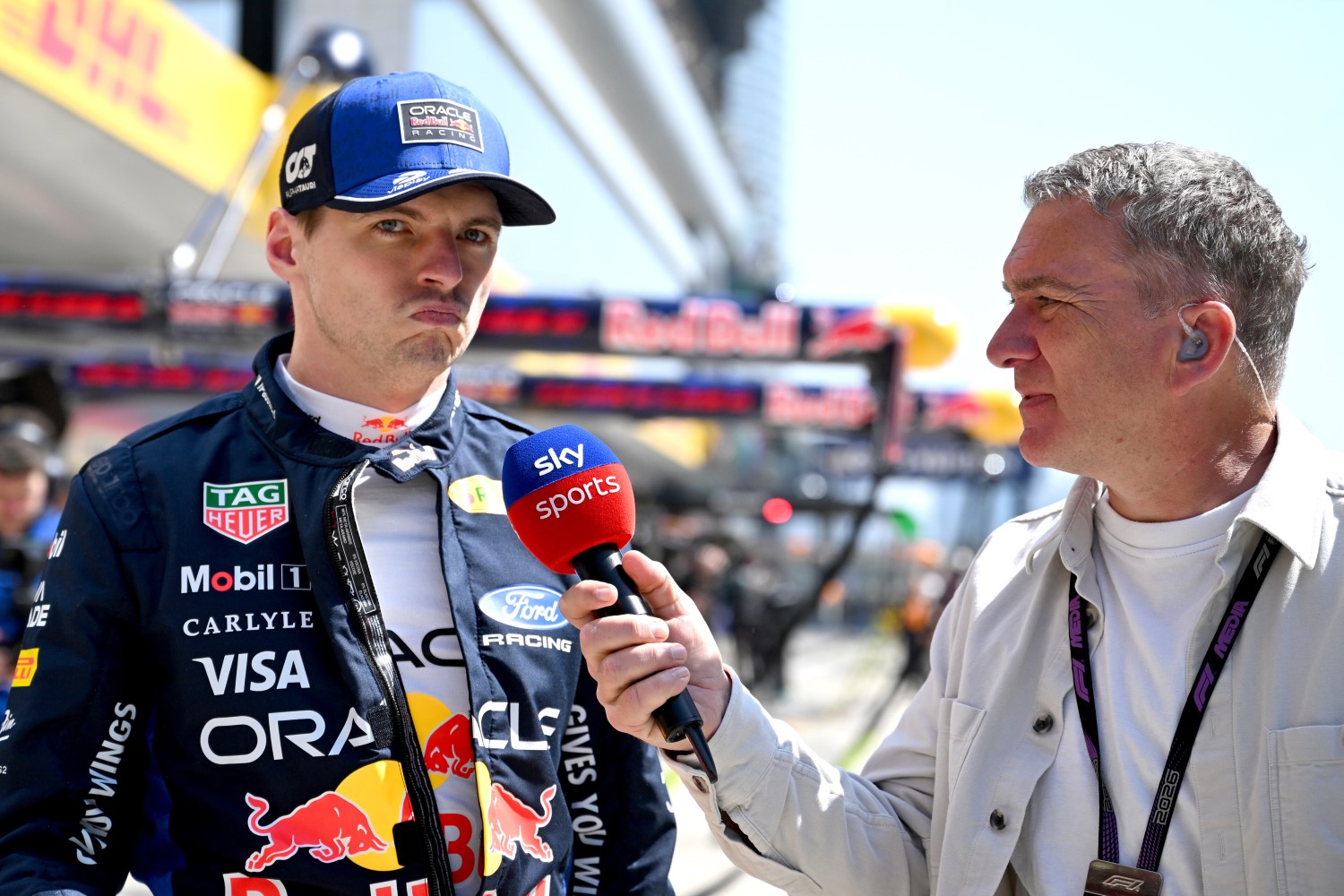
Max Verstappen (pictured with Sky Sports Craig Slater) has made no secret of his growing disillusionment with Formula 1. In recent weeks, the Dutchman has openly questioned whether he wants to continue racing beyond the end of the 2026 season — and those closest to the sport are treating the warning with genuine concern rather than dismissing it as post-race frustration.
–by Mark Cipolloni–
The root cause? The new 2026 regulations have, in Verstappen’s eyes, stripped the sport of the very thing that made it worth competing in: raw driver skill.
The 2026 cars place an unprecedented emphasis on battery harvesting and electrical power deployment. Drivers must constantly manage energy rather than attack corners or out-brake rivals in the classic sense. Verstappen has repeatedly described the new formula as “anti-racing,” “Formula E on steroids,” and even “playing Mario Kart” — where boosting past someone on one straight is immediately undone when the battery runs out on the next. “It’s terrible,” he said after a frustrating Chinese Grand Prix. “If someone likes this, then you really don’t know what racing is about. It’s not fun at all.”
Related Article: Formula 1 Rumor: Verstappen will quit Formula 1 after 2026
This isn’t a sudden outburst. Verstappen has voiced these concerns since early simulator runs in 2023. Now, with the cars on track and Red Bull struggling to adapt, his frustration has boiled over into talk of an early exit — despite a contract that runs to 2028.
Sky Sports F1 commentator David Croft is among those who believe the threat is real.
In a recent appearance on The F1 Show, Croft delivered a blunt assessment that should make the FIA, Red Bull, and the entire paddock sit up and take notice:
“No, I don’t think they’re empty threats at all… One thing that we’ve learned from Max from the 11 years that he’s been in Formula 1 is that he pretty much sticks to what he says.”
Croft went further, pointing out that Verstappen’s dissatisfaction runs deeper than car performance:
“For me, the expectation is he may well go at the end of this Red Bull contract anyway, but this is clearly not a formula and a format that he’s enjoying currently. Whether that Red Bull car is doing well or not, I don’t think it necessarily appeals to him.”
And in a direct message to anyone tempted to write it off as gamesmanship:
“He is just voicing his concerns for the sport. He’s voicing his concerns for himself and is saying in a very Max Verstappen way… ‘Look, if it’s not going to change for next year, if we’re going to have this sort of thing for years to come, I don’t really want to be a part of it. I don’t need it. I don’t need the money. There are other things I can go off and do.’”
Croft’s final point cuts to the heart of the matter: motorsport is dangerous. You don’t risk your life at 200 mph without passion.
“Max wants to get behind the wheel… and have fun racing. And if he’s not having fun, he will go off. And I think we should take this very, very seriously and not necessarily judge him on it either. If he’s not feeling the love for the actual sport, then don’t stick around.”
Croft isn’t alone. Former F1 driver and Sky Sports pundit Martin Brundle has urged Verstappen to either commit or stop talking about retirement, acknowledging the generational talent that would be lost: “I would hugely miss his talent, his generational speed and car control is something that very few people in the history of motorsport have had.”
Insiders echo the same sentiment. ESPN reports the threat has been “a long time coming” and is tied directly to the hybrid power units’ massive shift toward electrical energy management — exactly the element Verstappen says removes driver skill from the equation. Dutch journalist Erik van Haren, who has strong Red Bull connections, confirmed the champion has “principled problems with the way the current cars are set up.”
What makes Verstappen’s stance particularly credible is his character. He has never been one to chase headlines or play politics. He has already won four world titles, earned more than enough money, and maintains thriving interests outside F1—sim racing, virtual competitions, family time, and even other forms of motorsport. As Croft noted, he simply doesn’t need to be here if the joy is gone.
The 2026 regulations were meant to usher in a bold, sustainable future for F1. Instead, they have produced cars that many drivers (and now fans) feel turn racing into an energy-management exercise rather than a test of skill and courage. Verstappen’s frustration is shared by others, but few have the leverage—or the willingness—to say it out loud.
Whether the FIA and the teams listen remains to be seen. But one thing is clear from those who know him best: when Max Verstappen says he might walk away, he means it. The sport that once thrilled him now leaves him cold—and if the cars continue to prioritize batteries over brilliance, Formula 1 may soon have to race on without its biggest star.
He has a clear roadmap of what comes next
Max has been open for years about what life after F1 looks like to him. He’s not interested in chasing more titles for the sake of numbers, nor does he see himself returning to the sport in a management or team-principal role. Instead, he wants to do things that actually bring him joy — and he already has several thriving projects lined up.
1. More time with family and friends
This is the biggest recurring theme in his recent comments. After poor results and the frustration of the 2026 cars, he openly asked:
> “Is it worth it? Or do I enjoy being more at home with my family? Seeing my friends more when you’re not enjoying your sport?”
He’s repeatedly said he wants to “live my life” and “appreciate what is out there” rather than spend another 10–15 years grinding through 24-race seasons. A sabbatical or full retirement would give him that freedom immediately.
2. Expanding Verstappen.com Racing (his GT3 and endurance program)
Max already owns and runs Verstappen.com Racing, a real-world GT3 team that competes in events like the Spa 24 Hours and Nürburgring 24 Hours. He’s personally racing in the Nürburgring 24 Hours this year and has said he wants to “build that out further in the coming years.”
It’s not a hobby — it’s a passion project. He’s using it to give sim racers a genuine pathway into professional motorsport, which he calls one of his biggest dreams.
3. Sim racing and Team Redline
Max is one of the most dedicated sim racers on the planet. He regularly competes in iRacing endurance events (sometimes staying up until 3 a.m. the night before an F1 race) and co-owns Team Redline. He has made it clear that sim racing isn’t “just a game” to him — it’s where he finds pure racing joy without the politics or energy-management restrictions of modern F1. If he leaves F1, expect him to dive even deeper here, both competitively and as a mentor helping sim talent go pro.
4. Endurance and sports-car racing
He has explicitly ruled out an F1 management role but left the door wide open for other categories:
> “Outside of Formula 1… I don’t think I would ever come back in F1 in a management role… but in a different kind of category, more like endurance racing.”
Le Mans, more 24-hour races, and GT3 programs are all on his radar. He’s already proven he’s competitive in them and clearly finds them more fun than the current F1 formula.
Bottom line from Max himself:
“It’s not like if I would stop here that I’m not going to do anything. I’m always going to have fun. And also I will have fun in a lot of other things in my life.”
He’s 28 years old (turns 29 in September 2026), has four world titles, more money than he’ll ever need, and zero interest in racing just to tick boxes. Insiders say he’s leaning toward a sabbatical rather than a permanent full retirement, but even that could easily become permanent if the passion doesn’t return.
In short: if Max walks away, he won’t be “retiring” in the traditional sense — he’ll simply be shifting his energy to the racing he actually loves, spending real time with his family, and building the next generation of drivers through sim and GT3. The man who once said he races only because he loves it has already mapped out exactly what that love looks like without F1.