Formula 1 News: 2026 Miami GP Preview
The 11 Formula 1 teams are headed to the Sunshine State for Round 4 of the 2025 FIA Formula 1 World Championship, the Miami GP, at the Miami International Autodrome.
–by Mark Cipolloni–
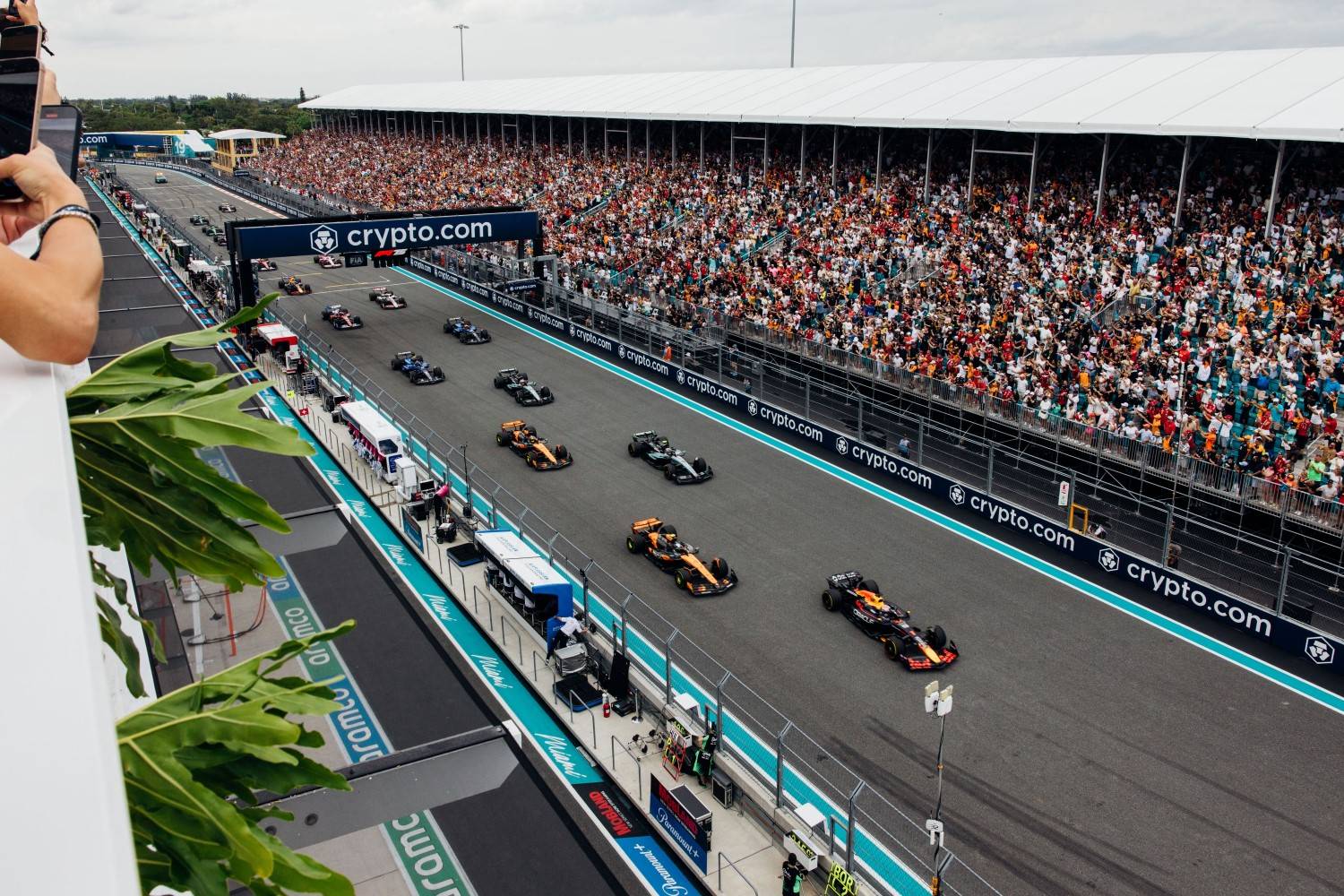
The Miami Grand Prix has been a calendar highlight since joining Formula 1 in 2022. The Hard Rock Campus, home to the NFL’s Miami Dolphins, transforms into a world-class F1 venue each year. The 3.3-mile Miami International Autodrome snakes around the grounds, with the pit lane and paddock nestled beside the 65,000-seat Hard Rock Stadium — which will also host matches during this year’s FIFA World Cup. The popular F1 Village sits on the stadium pitch itself, creating an electric atmosphere.
The circuit offers a mix of corner types and two long full-throttle straights that encourage wheel-to-wheel racing. Yet the tricky off-camber sections, tight walls, and low off-line grip (due to the track’s infrequent use) make it a real challenge. For the third straight year, Miami hosts the F1 Sprint format. That means teams get only one extended 90-minute practice session on Friday to get up to speed before the weekend’s high-stakes action begins.
F1 Academy returns once again as part of the support program.
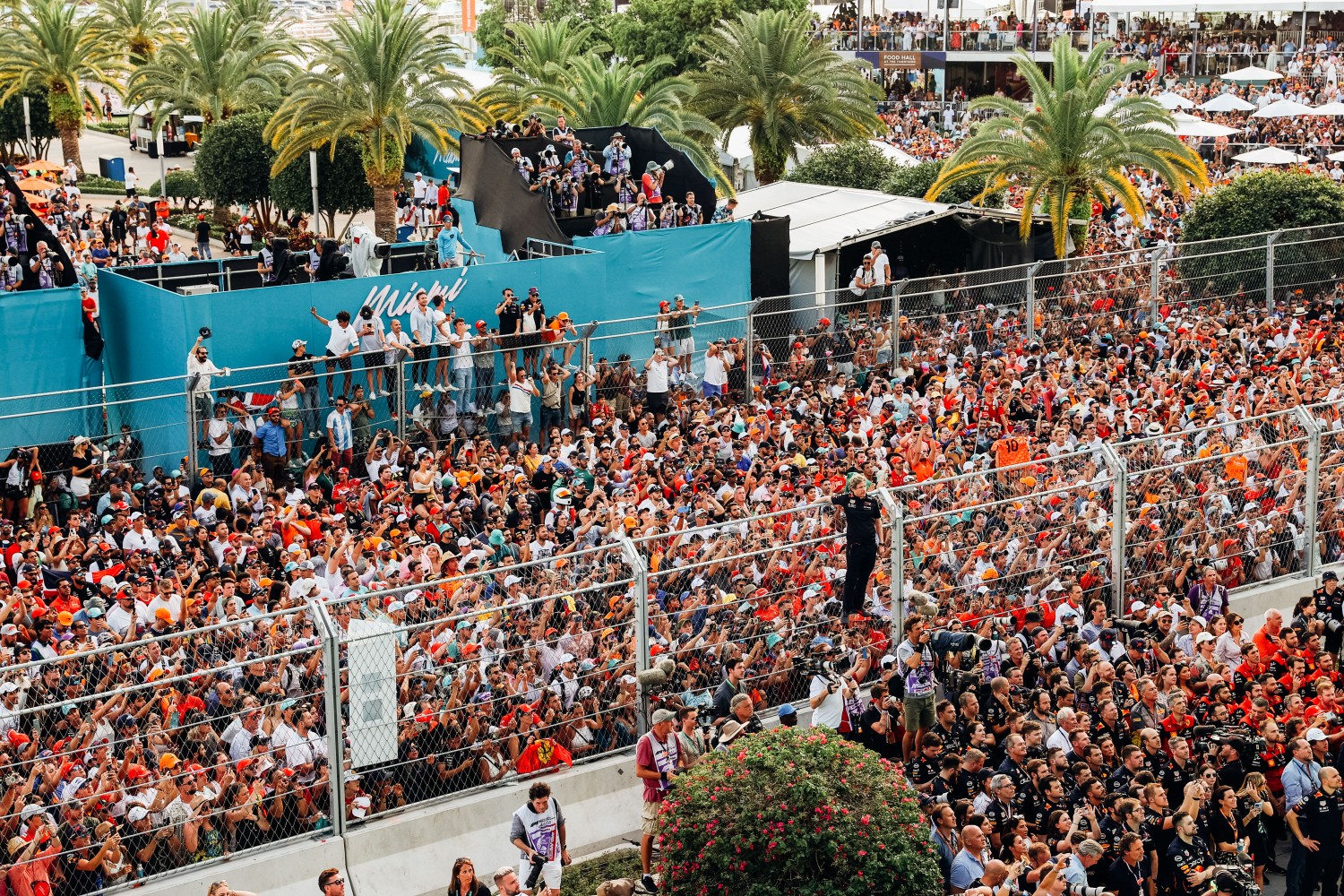
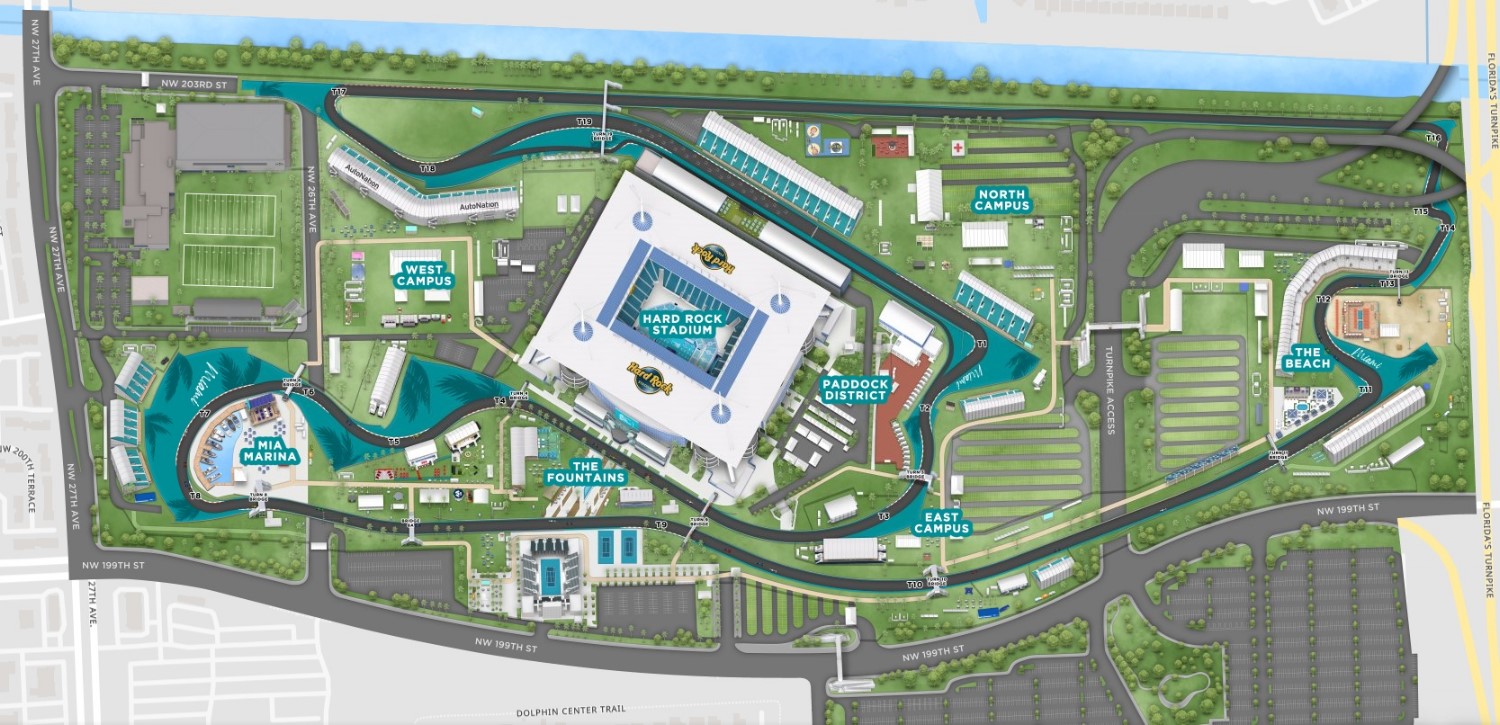
The start/finish line and pit lane will be located adjacent to the Hard Rock Stadium, where the likes of Taylor Swift, The Rolling Stones and U2 once played, and which will now reverberate to the sound of Formula 1 machinery. Formula 1 is ready to thrive in ‘The 305’.
Fact File: Miami Grand Prix
This will be the fifth Miami Grand Prix, with the race first appearing on the calendar in 2022.
This year, Free Practice 1 will run for 90 minutes to account for the long gap since the last Grand Prix, recent regulatory and technical changes, and the reduced practice time under the Miami Sprint format.
The 5.412 km Miami International Autodrome became the 11th track based in the USA to host a Grand Prix. Las Vegas became the 12th when it debuted on the calendar in 2023.
The Miami International Autodrome is one of nine on the 2026 F1 calendar to run in an anti-clockwise direction.
Miami hosted the F1 Sprint format for the first time in 2024 and, like last season too, will do so again in 2026.
75 different circuit patterns were designed, and 36 simulated, before the final track layout was decided on before the first race in 2022.
The circuit races around the grounds of the Hard Rock Stadium, home to the Miami Dolphins NFL team and the Miami Open ATP and WTA tennis tournaments.
The car setup must balance high-speed and low-speed performance. The track has quick corners at the start and end of the lap and two long straights connected by a slow, technical middle section, requiring a setup compromise
Being a temporary venue around the Hard Rock Stadium, the track surface evolves significantly throughout the weekend, meaning grip levels change from session to session
The warm Florida climate often creates hot conditions which put additional strain on both the car and drivers. Track temperatures exceeding 50°C cause significant rear tire overheating, especially through the slow-speed middle section and during traction phases, making tire management critical throughout the lap
In 2026, focus and resource allocation for energy management has greatly increased, particularly the time spent by drivers preparing in the simulator. This is even more important as Miami is a Sprint event, limiting practice time.
The nature of the circuit at Miami makes the energy management challenge slightly easier than at previous races, with plenty of opportunity to harvest ahead of the long, energy-sensitive straights
The FIA regulation changes introduced ahead of Miami reduce the challenge; however, we are still tackling the same problems around out-lap preparation, optimizing deployment and harvest, and developing a robust plan for fighting other cars in the race
The 2026 regulations define three Straight-Line Mode (SLM) zones: the start/finish straight, the run between Turns 8 and 11, and the back straight. The second zone will be disabled in wet conditions, and if a WET hazard is declared, teams have a specific exemption to raise the front ride height under Parc Fermé
Along with Austria and Las Vegas, Miami has the highest number of heavy braking events on the calendar, with three.
Max Verstappen and Red Bull won the first two editions of this race, in 2022 and 2023, while Lando Norris secured his maiden Formula 1 win hin 2024 with McLaren. Last year it was a McLaren 1-2 with Oscar Piastri beating teammate Lando Norris. Each year has seen a different driver take pole position until last year: Charles Leclerc and Ferrari in the inaugural edition, followed by Sergio Perez (Red Bull) in 2023, with his teammate Max Verstappen securing the number one slot in 2024 and 2025.
So far, the quickest driver in qualifying has never won the race, but has always finished second. Apart from the four aforementioned drivers, only two others, the Spaniards Fernando Alonso and Carlos Sainz, have made it to the podium, both in third place.
This year’s Miami Grand Prix will be the 83rd round of the Drivers’ Formula 1 World Championship to have been held in the United States of America, since its inception in 1950. The USA thus moves ahead of Germany and Great Britain to take second place on the list of countries to have hosted the most Grands Prix, leaving Italy out in front on 107.
To date, eleven venues have hosted these races: Austin (12 Grands Prix,) Dallas (1), Detroit (7), Indianapolis (19), Las Vegas (4), Long Beach (8), Miami (3), Phoenix (3), Riverside (1), Sebring (1) and Watkins Glen (20).
Curious fact: the two drivers with the most USA wins will be racing this weekend in Miami and they are Lewis Hamilton and Max Verstappen with six victories apiece. As for the teams, thanks to Leclerc’s win in Austin last year, Ferrari is now the most successful team in the USA with 14 wins to its name.
The track in Miami ranks high in terms of top speeds achieved comparative with other circuits, with only Monza, the Circuit Hermanos Rodriguez in Mexico, Baku, and Las Vegas seeing higher top speeds this season. Miami together with Baku are amongst the highest circuits for drag sensitivity.
After the first edition of the race in 2022, the track was resurfaced with a new aggregate, offering improved grip for the drivers with the aim of increasing overtaking opportunities.
The Miami International Autodrome is one of nine on the 2025 F1 calendar to run in an anti-clockwise direction.
USA TV Schedule
All Times Eastern
| Friday, May 1, 2026 | Location | TV Times | Network |
| Formula 1 Miami GP Practice 1 | Miami, FL | 11:40am – 1:00pm (Live Stream) | Apple TV |
| Formula 1 Miami GP Sprint Qualifying | Miami, FL | 4:10pm – 5:30pm (Live Stream) | Apple TV |
| Saturday, May 2, 2026 | Location | TV Times | Network |
| Formula 1 Miami GP Sprint Race | Miami, FL | 11:15am -12:00pm(Live Stream) | Apple TV |
| Formula 1 Miami GP Qualifying | Miami, FL | 3:25pm (Live Stream) | Apple TV |
| Sunday, May 3, 2026 | Location | TV Times | Network |
| Formula 1 Miami GP Pre-Race | Miami, FL | 2:50pm -4:00pm (Live Stream) | Apple TV |
| Formula 1 Miami GP Race | Miami, FL | 4:00pm -6:00pm (Live Stream) | Apple TV |
| Formula 1 Miami GP Race | Miami, FL | 4:00pm -6:00pm (Live Stream) | IMAX Theaters |
| F1 Kids Miami GP Race | Miami, FL | 4:00pm -6:00pm (Live Stream) | Apple TV |
Last Year’s Race
The superior McLarens destroyed the field in the 2025 GP of Miami at the Miami International Autodrome, with Oscar Piastri winning his 4th F1 race of the year.
Oscar Piastri and Lando Norris easily passed polesitter Max Verstappen in the Red Bull sled and left him 40s behind at the finish, such was the dominance of their superior McLaren designed by Rob Marshall.
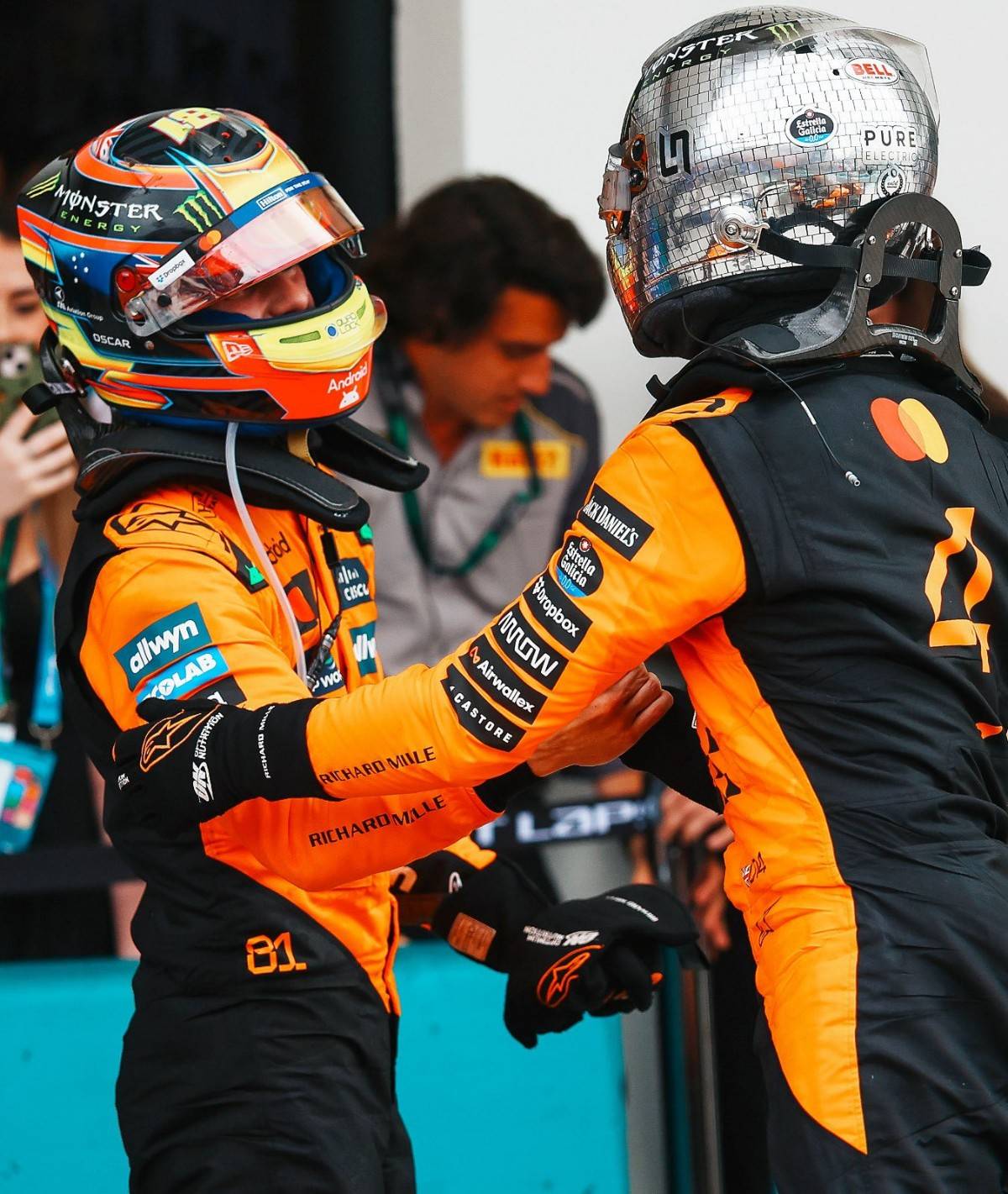
“I won the race that I really wanted to – yesterday was tricky, Qualifying was one of my trickiest sessions of the year so to come away with the win is an amazing result,” said a happy Piastri.
“I was aware enough to avoid Max in Turn 1, and from then I knew I had a good pace advantage. The car was incredible today.
“The hard stint I was struggling a little bit, so there are some things to work on. Got to keep learning, but very happy to be leaving Miami on top.”
“Two years ago here we were the slowest team, I think we got lapped twice. Here, we just won the race by 35 seconds.” That is because Chief Designer Rob Marshall was poached from Red Bull and has made the McLaren unbeatable. Marshall was the man who made the Red Bull so fast a few years ago, but Adrian Newey got the credit, so Marshall bolted to McLaren to prove a point.
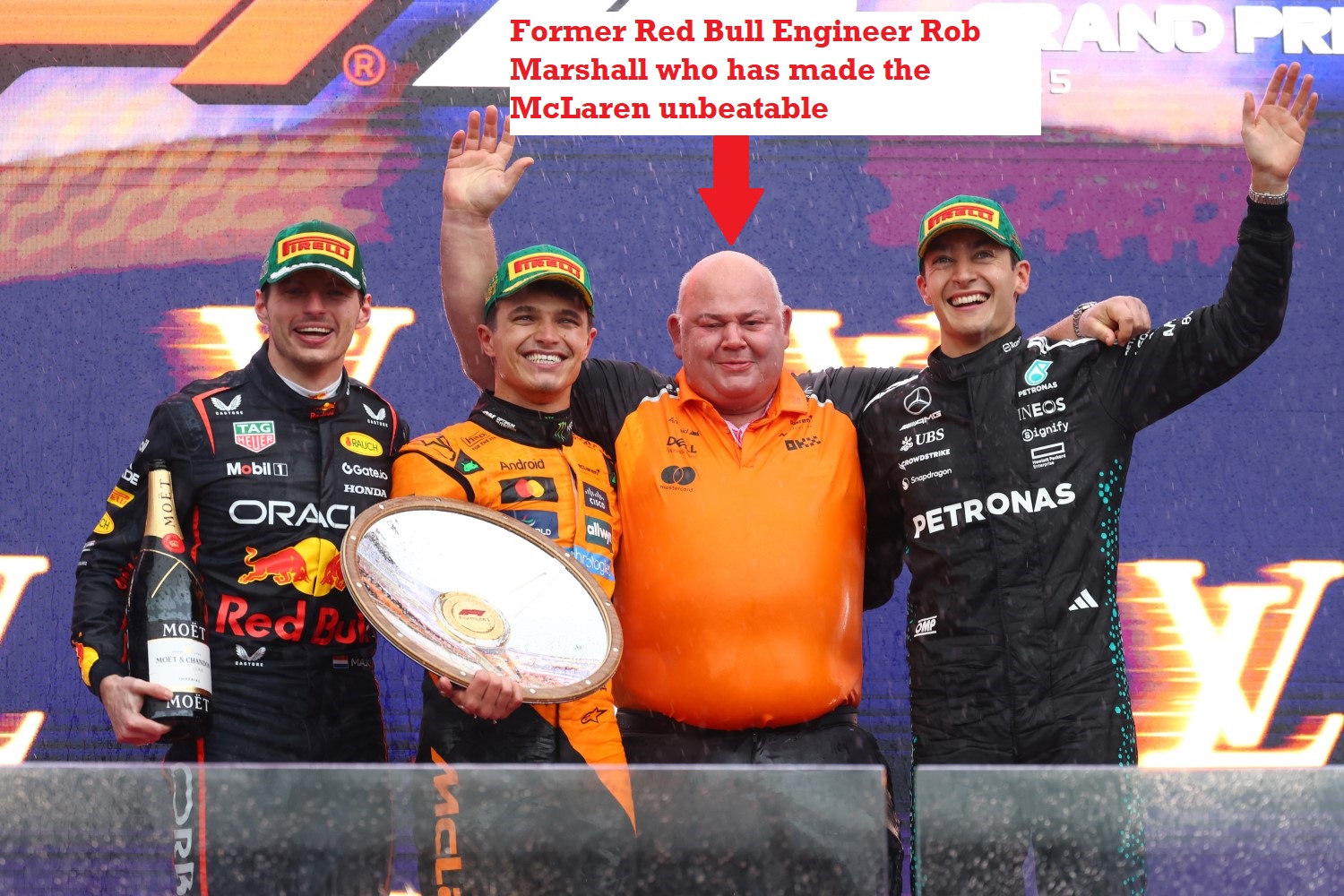
“It’s never the best feeling [to be P2] but the team has done an amazing job, so I can’t fault them at all,” said Norris.
“We were up the road so it is a good feeling. Oscar drove well, Max put up a good fight as always so it is what it is. I paid the price for not doing a good enough job today, but still happy to be second.”
Verstappen lost the final podium position because George Russell’s Mercedes gained 10-seconds on him because he pitted under a Virtual Safety Car. Russell was 37s behind Piastri at the finish – and out to lunch.
“”Really happy to come away with P3 as I have been struggling this weekend personally,” said Russell.
“Well done to the McLaren, they were just too far down the road. Lando is upset with me as we had a crash in the Lego race and I hurt his leg!”
It was the 4th win of the year for Piastri and his 6th F1 career win and his third straight win. Piastri now has more wins than his teammate Lando Norris.
What’s the track like?
The 5.412 km venue is located around the Hard Rock Stadium in Miami, featuring 19 corners, 12 left-handers and seven right. The layout is interesting, because it features many low and high-speed corners, but not very many in the mid-range. There are also several long straights and three DRS zones.
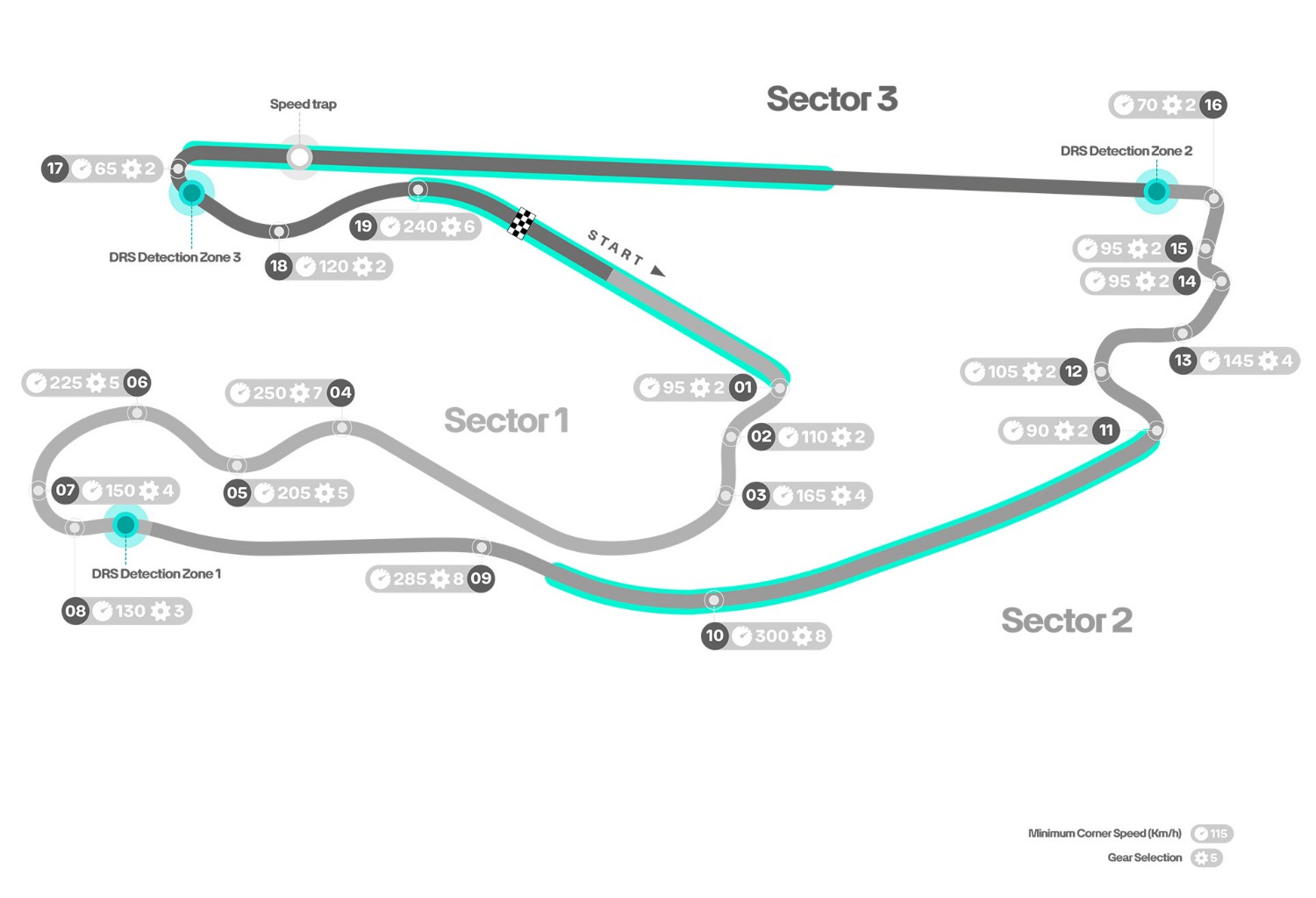
Race distance (km) 308
Number of laps 57
Number of corners 19
Because the slow corners are often followed by long straights, low-speed traction on corner exits will be important and a compromise is required with the car set-up. You want a high ride height with high downforce for the fast corners early on, a low drag set-up for the long straights and then a lower ride height with a high downforce level for the twisty sections. So, you must weigh up where the priorities are and what will get you the most lap time.
The sectors are all quite different. Sector one is dominated by faster, sweeping turns, while the second includes more of the slower turns. Sector three is dominated by the long back straight and the hairpin. Track evolution on the new surface is likely to be high, so lap times will be tumbling as the weekend progresses.
Surprisingly, the track’s characteristics share a few similarities with venues like Barcelona, in that the high-speed corners are early in the lap, therefore heating up the tires, and the end of the lap features twisty corners where the hot tires suffer – as there is no grip left. However, tire overheating might be a bit easier than in Barcelona, due to Miami’s long straights.
Track Insight
Miami is one of the easiest tracks of the season for overtaking. This puts a strong emphasis on race pace over qualifying pace
The Grand Prix is expected to be a 1-stop featuring medium and hard tyres, although all three compounds are viable race tires. Some drivers could attempt an alternative strategy starting on soft tires and avoiding the hard
Statistically, this track has a high VSC (Virtual Safety Car) probability. A well-timed VSC could give drivers yet to pit a significant advantage or incentivise drivers to make an extra stop
A small increase in tire degradation could see the field shift to 2-stop races
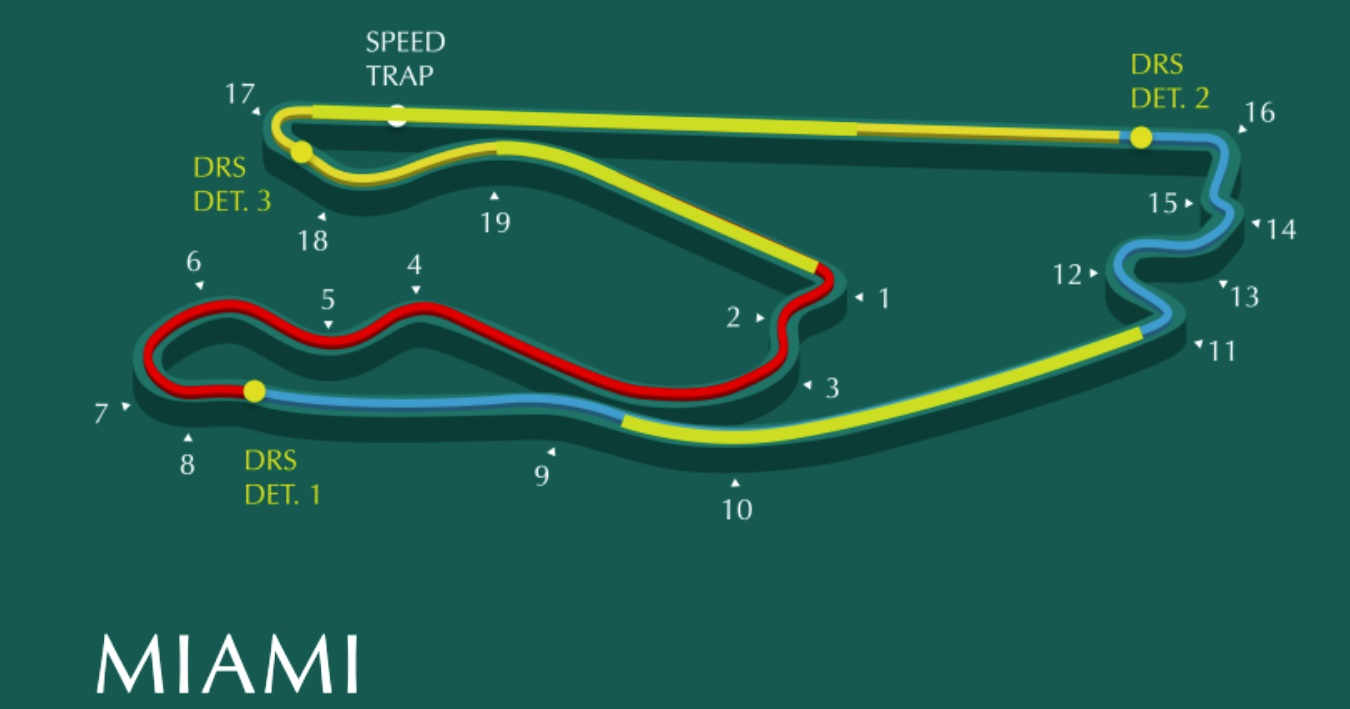
- Turns Six, Seven and Eight are a tricky combination of consecutive left-handers that flow into each other. Getting braking right on entry for this sequence is difficult, and the exit is just as important with a long, full-throttle run spanning all the way to Turn 13.
- Turn 13 might not look like much on paper, but it is deceptively tricky. It is slightly uphill, awkwardly cambered, and leads into a very tight, slow chicane. Large amounts of time can be lost in this sequence, which is far from ideal, as the longest straight on the circuit is shortly after this area of the track.
- At the end of the long straight is Turn 17. Cars will decelerate from 325 to 67 km/h in under 100 meters in this heavy braking zone. The corner opens up on exit, and defending out of it is far from easy through Turns 18 and 19 and down the start-finish straight, especially with a DRS zone aiding overtaking into Turn One
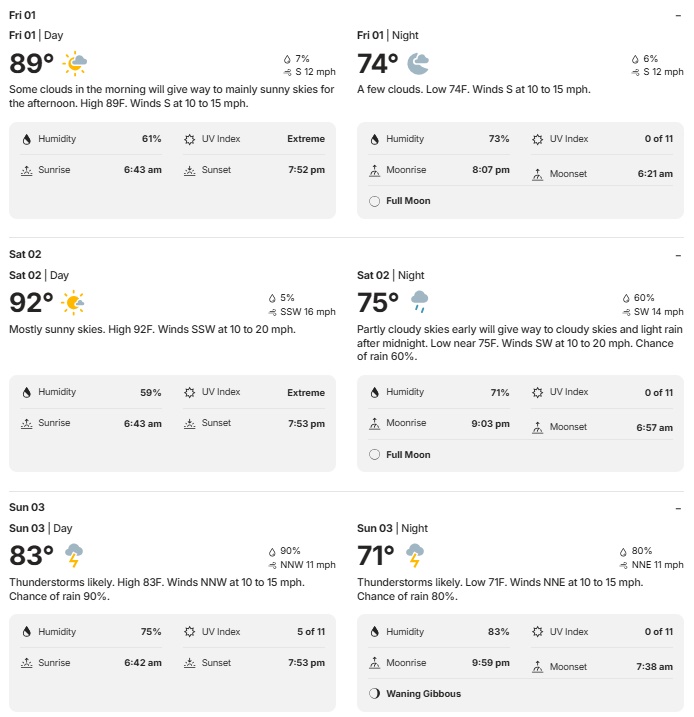
Weather Forecast
Pirelli’s Perspective on Miami GP
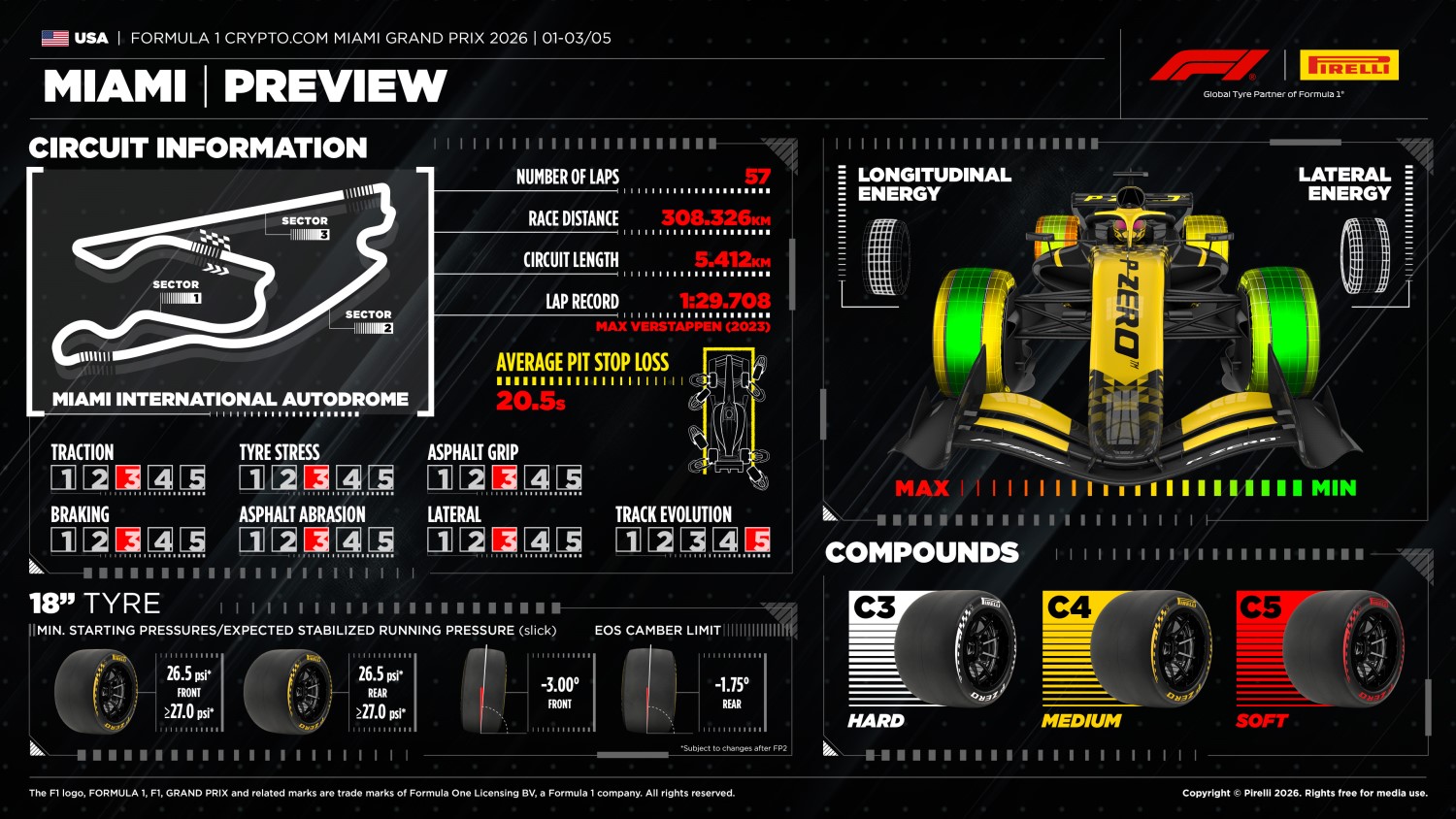
To tackle the 19 corners and three long straights of the Miami International Autodrome, as it was named for its inaugural race in 2022, teams will have access to the three softest compounds in the Pirelli range: C3, C4 and C5. The asphalt, resurfaced in 2023, has a low level of roughness and gains grip over the course of the weekend as the track evolves.
One interesting characteristic that emerged last year was how quickly the circuit dried. This was clearly demonstrated during the Sprint, the short race that will also feature this season, when drivers switched from intermediate tyres to slicks during the 19 laps, despite the heavy rain that had fallen before the lights went out. Variable weather conditions could once again spring surprises over the course of the weekend.
There should be fewer uncertainties when it comes to race strategy. Tyre degradation in Miami has always been limited, thanks to the characteristics of the circuit, allowing drivers to extend their stints and make just a single pit stop during the race. Another factor to consider on Sunday is the possibility of neutralisations, which are common on any street circuit, where precision is crucial to avoid contact with the barriers.