Formula 1 Editorial: F1’s 2026 package was a step too far in the name of fake “sustainability”
They were stupid enough to get themselves into this mess in the first place.
After three races of the 2026 season, Formula 1 is already rushing through emergency rule tweaks for this weekend’s Miami Grand Prix — a blatant admission that the overhauled “next-generation” cars are a flawed experiment that has turned pure racing into a glorified energy-management video game.
–by Mark Cipolloni–
The FIA’s latest fixes, confirmed this week, are the latest in a long line of mid-season bandaids for cars that drivers themselves have labeled “anti-racing.” The changes revolve entirely around the power units’ energy harvesting and deployment systems—the very heart of the 2026 regulations that everyone now admits went too far.
Here’s what’s changing, and why it exposes the whole farce:
– The “super-clipping” limit (when the car deliberately slows at full throttle to harvest energy) jumps from 250 kW to the full 350 kW.
– Qualifying energy harvesting drops from 8 megajoules to 7 (and could go as low as 6 for up to 12 races).
– Electrical power deployment is now restricted: full 350 kW only in designated “key acceleration zones” on straights, capped at 250 kW elsewhere, and just 150 kW on starts or low-power situations.
The goal? Stop the ridiculous yo-yo effect where drivers lift-and-coast through corners that used to be flat-out, eliminate random speed drops in qualifying, and reduce dangerous closing-speed differentials that nearly killed Oliver Bearman at Suzuka.
All of it decided after thousands of simulations, endless meetings, and frantic analysis following the Chinese and Japanese Grands Prix. And because every track has its own layout, corners, and overtaking zones, these tweaks have to be mapped, simulated, and approved individually for all 24 circuits on the calendar.
This is no longer racing. It’s chess with 350 kW batteries.
Related Article: Formula 1 News: Video explaining how Frankenstein Cars have ruined Formula 1
As four-time world champion Max Verstappen has repeatedly hammered home, the cars feel nothing like Formula 1. “It feels a bit more like Formula E on steroids,” he said after testing. “A lot of what you do as a driver… has a massive effect on the energy side of things. For me, that’s just not Formula 1… everything else is a bit, for me, anti-racing.”
He’s not alone. Multiple drivers have complained the cars demand more energy management than outright speed. Charles Leclerc called the qualifying spectacle “Mario Kart.” The sport’s own governing body is now admitting the patient needed emergency surgery just three races into the season.
FIA single-seater director Nikolas Tombazis tried to put a positive spin on it, calling the tweaks an “evolution, not a revolution.” Translation: We built something broken, and now we’re patching it on the fly rather than admitting the whole 2026 package was a step too far in the name of fake “sustainability” and manufactured spectacle.
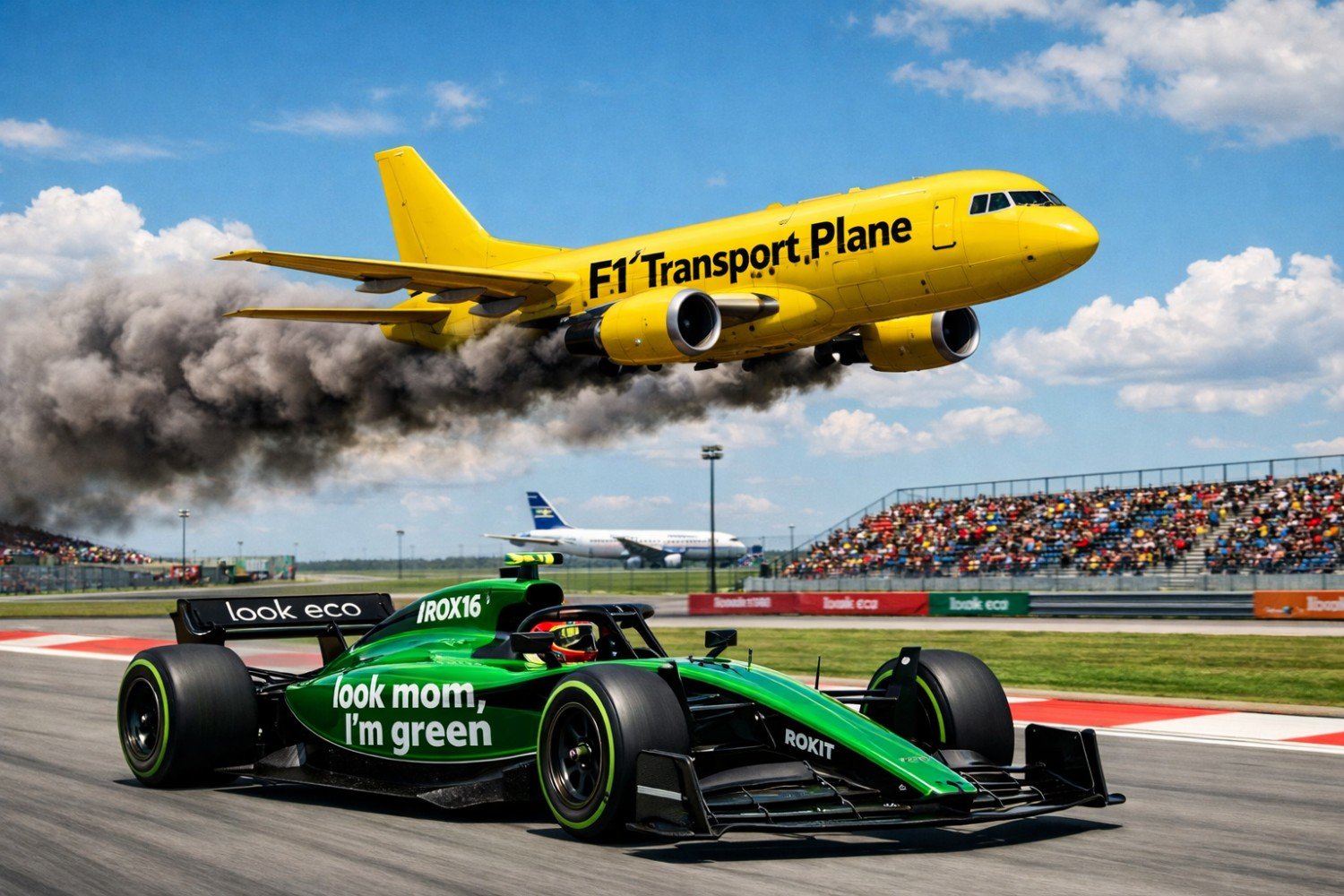
The bitter irony is that while F1 obsessively chased performative “sustainability” by crippling its 2026 cars with overly complex hybrid systems and energy-management rules, the sport continues to pollute the planet on an industrial scale. The cars racing on track account for less than one percent of Formula 1’s operational carbon footprint.
The real emissions come from hauling thousands of tons of equipment around the world on cargo planes, teams and staff jetting between 24 countries, and hundreds of thousands of fans burning fossil fuels to fly or drive to the races — pushing the true annual footprint well over one million tons of CO₂.
Yet instead of addressing the actual environmental elephant in the room, the powers-that-be decided the best solution was to turn the pinnacle of motorsport into a glorified energy-harvesting exercise. They sacrificed raw racing for green PR, all while the private jets kept flying and the freight ships kept sailing.
Teams will implement the changes via software updates—no new parts, just more code telling the cars how to behave differently depending on where they are on track. Because nothing says “pure racing” like GPS-tracked power limits and pre-approved lift points.
The irony is brutal. F1 spent years hyping these ground-effect, active-aero, hybrid-heavy monsters as the future. Now they’re spending thousands of simulation hours just to make them marginally less awful to watch and safer to race. All because someone decided that forcing drivers to nurse batteries mid-corner was somehow more exciting than letting them drive flat-out.
It isn’t.
This weekend in Miami we’ll see slightly flatter qualifying laps and marginally safer racing. But the fundamental problem remains: these are no longer the cars drivers dreamed of growing up watching. They’re over-engineered, over-managed hybrids that prioritize efficiency targets over outright speed and skill.
And the saddest part? Verstappen has already hinted he might walk away at season’s end if the fixes aren’t big enough for 2027.
Formula 1 created its own monster. Now it’s desperately trying to tame it with loopholes, simulations, and last-minute rule tweaks.
The real question is whether Formula 1 fans still remember what pure racing is supposed to look like.
Related Article: The Frankenstein Cars of 2026: How F1’s New Regulations Have Stripped Away the Pure Art of Racing